The digital asset market has evolved rapidly, moving from a space dominated by retail and speculation to gradually become a critical infrastructure for institutional finance.
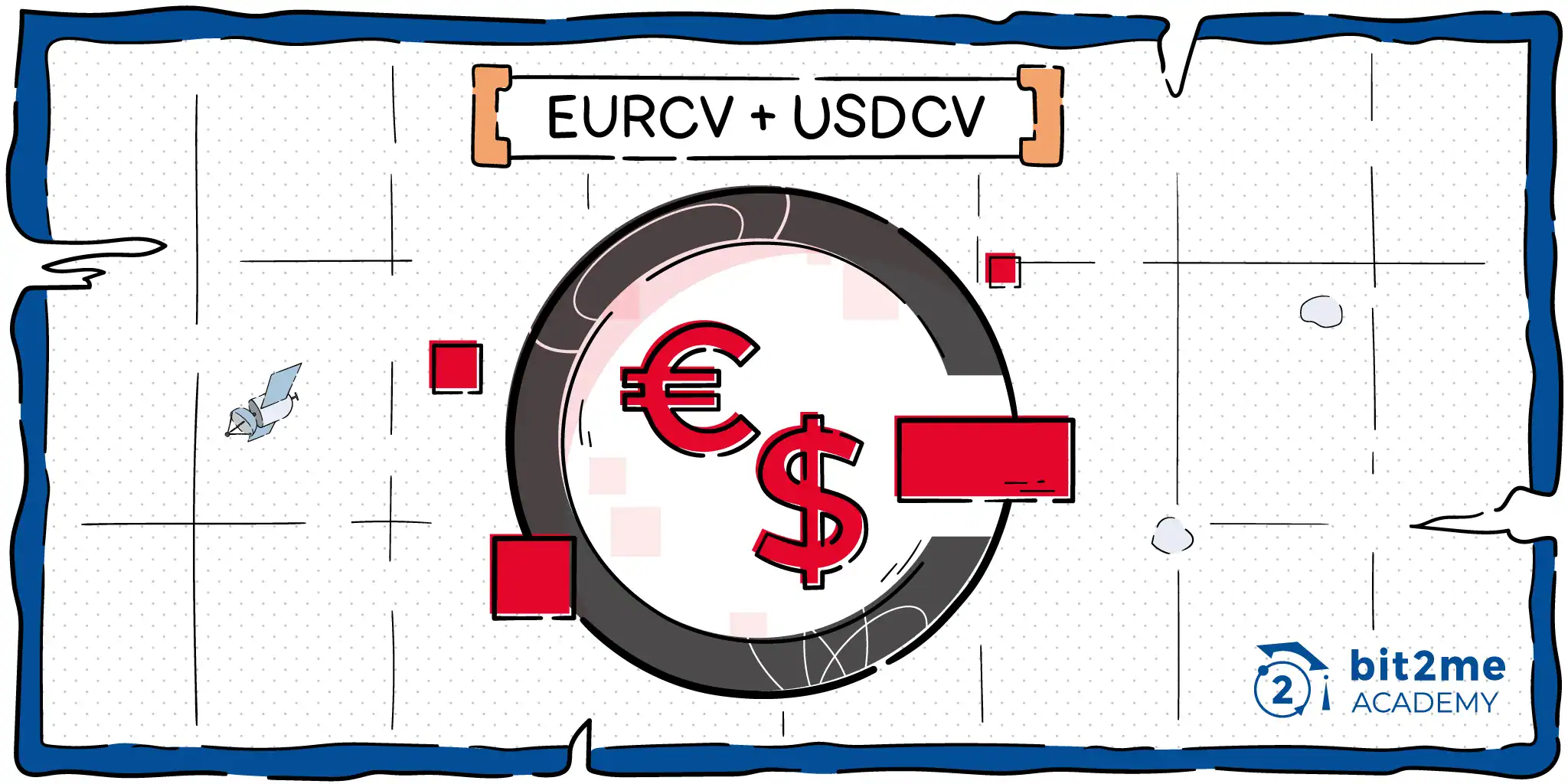
And it is in this context that a new generation of stable cryptoassets backed by top-tier banking institutions is emerging, assets specifically designed to meet the regulatory compliance and stability requirements of the traditional financial system (TradFi). This is the case of EUR CoinVertible (EURCV) and USD CoinVertible (USDCV), jointly known as CoinVertible, two stable crypto assets or stablecoins, which seek to maintain a 1:1 parity with their respective reference fiduciary currencies, the Euro (€) and the US Dollar ($).
These assets are presented as fundamental tools for building digital bridges, facilitating on-chain transaction settlement and liquidity management within institutional environments, combining the efficiency of distributed ledger technology (DLT) with the inherent security of traditional banking.
The entity behind CoinVertible: Société Générale – FORGE (SG-FORGE)
However Who's behind these stablecoins? Well, the credibility and structure of CoinVertible stablecoins derive directly from its parent company: Société Générale (SG).
Société Générale (SG), the epicenter of everything
Société GénéraleFounded in 1864, SG is one of France's largest banking and financial services groups. SG's longevity and scale in global finance undoubtedly raise the profile of any asset it issues, especially in the stablecoin space, where trust in the issuer is paramount.
The bank's prestige acts as an intangible asset, validating the security and solvency of CoinVertibles at a level that non-bank issuers fail to fully achieve—a decisive factor in a post-MiCA regulatory environment.
SG-FORGE, the institutional digital arm
SG-FORGE, for its part, is Société Générale's subsidiary dedicated specifically to digital assets. Its mission is not simply to experiment with DLT, but to provide institutional-grade cryptoasset services, including the issuance and management of financial assets and on-chain products for clients ranging from investors to corporations and financial institutions.
SG-FORGE SG-FORGE has been actively involved in the issuance of digital bonds and native structured products on networks like Ethereum and Tezos since 2019. This track record confirms that the launch of CoinVertible is not a one-off effort, but rather an extension of a mature tokenization strategy. SG-FORGE's stated goal is clear: "to bridge the gap between traditional capital markets and the digital asset ecosystem."
An analysis of SG-FORGE's track record in digital bond issuance suggests that its strategic focus is on B2B (Business-to-Business) infrastructure and capital markets, rather than the retail market. Therefore, CoinVertibles are best understood as settlement and risk management tools designed for institutions, intended to optimize large-scale liquidity workflows within a strict compliance framework.
Ecosystem, regulation and the MiCA paradigm in the European Union
CoinVertible's integration into the crypto sector and the European regulatory system is marked by an undeniable adherence to the MiCA framework, which defines its architecture and value proposition.
Full adherence to MiCA
SG-FORGE has ensured maximum regulatory compliance. The subsidiary obtained an Electronic Money Institution (EMI) license from the French Autorité de Contrôle Prudentiel et de Résolution (ACPR), a prerequisite for operating under the MiCA Regulation (EU) 2023/1114.
Both EURCV and USDCV are legally classified as Electronic Money Tokens (EMT), granting them free transferability within the regulated framework while maintaining high security and compliance standards. This classification is vital: EURCV has been fully supported since the implementation of MiCA regulation for stablecoins on July 1, 2024, while USDCV has been supported since its launch on June 25, 2025.
Access Controls: KYC/AML and Whitelisting
A distinctive feature of CoinVertible, which underlines its institutional approach, is the comprehensive implementation of strict controls. Anti-Money Laundering (AML) y Know Your Customer (KYC).
To purchase EURCV or USDCV directly from SG-FORGE, users must go through an onboarding process that includes whitelisting their blockchain addresses. Transfers of these stablecoins can only be made between Ethereum addresses (or other supported networks) that have been pre-authorized by SG-FORGE. While smart contract updates now allow for direct transfers between whitelisted addresses without requiring SG-FORGE intervention for each transaction, control of the address list remains centralized.
This high degree of centralization and the whitelisting requirement are, for SG-FORGE, a means to facilitate more robust regulatory compliance and aid in the prevention of theft and illicit activities. This is a strategic choice that trades open decentralization for regulatory certainty that specifically appeals to institutional clients. The cost of this centralization is the guarantee that the asset operates within the strict legal boundaries required by traditional finance.
Regulatory competitive advantage in the EU
MiCA regulation has caused a significant restructuring in the European stablecoin market. MiCA-compliant assets, including EURCV and EURC, have collectively captured up to 67% of the euro market share in the bloc. This drastic shift in market dynamics was primarily driven by mandatory exchange delistings, rather than a massive, organic increase in demand.
This phenomenon demonstrates that regulatory compliance is the most effective barrier to entry and that SG-FORGE's strategy capitalizes on a niche where legality crowds out unregulated competition. Furthermore, this regulatory influence is extending to dollar-backed stablecoins. Major European platforms have announced plans to stop listing non-compliant assets (such as USDT) for EU users, which directly benefits MiCA-compliant USD stablecoins, including USDCV.
Technical characteristics, collateralization and competitive differentiation
The CoinVertible structure is designed to differentiate itself from native stablecoin projects through a focus on banking security, top-tier custody, and legal transparency.
Fundamentals of collateralization
Both CoinVertibles are designed for full collateralization (100%), meaning they are backed 1:1 by bank cash deposits or high-quality securities.
What elevates the degree of institutional trust is the asset segregation mechanism, which ensures that collateral funds are legally and accountingly separated from SG-FORGE's general assets. These funds are held by a reputable trustee and are allocated exclusively to back the value of the tokens.
This structure is crucial because it makes the funds bankruptcy-remote in the event of SG-FORGE's insolvency. For an institutional client, this counterparty risk mitigation and the legal guarantee of direct recourse to collateral assets are essential, addressing the trust gaps observed in the less regulated stablecoin market.
To ensure maximum transparency, SG-FORGE updates and publicly discloses the collateralization level, as well as the composition and valuation of assets, on a daily basis.
World-class custody
Trust is reinforced by the selection of custodians. For USDCV, the Bank of New York Mellon (BNY Mellon) acts as the reserve custodian. The participation of BNY Mellon, a key player in global custody, is critical, as it enables a "seamless integration between traditional and digital financial ecosystems."
Multi-chain architecture
CoinVertible has adopted a multi-chain strategy, selecting networks based on the functional requirements of each currency:

The choice of Stellar for the euro and Solana for the dollar is not random, but rather a matter of product sophistication. It reflects an architecture designed for the specific function of the base currency: Stellar is better suited to institutional cross-border payments in euros, while Solana is better suited for the high throughput required by dollar-dominated crypto trading volumes.
 Certificate
Introductory course to DeFi
Medium levelTime to update. Traditional finance has changed, discover the revolutionary ecosystem of decentralized finance (DeFi).
Institutional use cases and applications in the real economy
The EURCV and USDCV use cases are firmly rooted in the operational efficiency of capital market finance, seeking to optimize processes that are slow and costly in legacy TradFi systems.
Settlement and financial services
CoinVertibles are designed as settlement assets. EURCV, in particular, streamlines cross-border payments with faster settlements and lower fees compared to traditional banking methods. By leveraging Stellar's infrastructure, EURCV eliminates the need for intermediaries, reducing both costs and processing times.
Their primary focus is on-chain settlement, where they act as a valuable asset for transactions that require 24/7/365 operational efficiency, something impossible with legacy clearing and settlement systems.
Treasury and risk management
For large corporations and financial institutions, CoinVertibles are treasury management tools. They provide digital solutions for cash management and efficient cash pooling, allowing companies to consolidate and move liquidity instantly.
A critical use case is the provision of intraday liquidity. These tokens are an effective solution for addressing high-frequency liquidity needs, such as collateral management or responding to margin calls in an instant and programmable manner. In performing this function, EURCV and USDCV compete directly with traditional bank deposits and money market funds. Their added value lies in the programmability and continuous (24/7) settlement offered by DLT, overcoming the operational limitations of traditional banking.
Additionally, they offer institutional investors a diversification option, serving as a stable digital asset for managing savings and investments, offering a less volatile alternative to unlinked cryptoassets.
Adoption on regulated exchanges
SG-FORGE's strategy focuses on distribution through channels that also comply with MiCA. Highly regulated European platforms like Bullish Europe have become key platforms for listing USDCV, while Bitstamp listed EURCV. This strategy ensures that adoption occurs within an ecosystem that prioritizes trust and compliance.
Despite the overall stablecoin market being dominated by the leading crypto-natives (USDT and USDC), which account for the vast majority of the circulating supply, EURCV trading volume has demonstrated significant growth, reaching daily volumes of around $34.40M USD in 24 hours.
This growth indicates a growing demand for MiCA-compliant alternatives within the institutional sphere. However, a paradox emerges: although regulatory compliance is robust, TradFi-backed projects initially struggle to gain traction against the massive network effect of established stablecoins. This underscores that the key to long-term success will depend on an aggressive distribution strategy and leveraging strategic partnerships (such as BNY Mellon and the Bullish/Bitstamp listings) to overcome market inertia.
Conclusion
EUR CoinVertible (EURCV) and USD CoinVertible (USDCV) represent a crucial milestone in the convergence of traditional finance and distributed ledger technology. They are not simply new stablecoins, but rather the manifestation of how global banking (Société Générale) is channeling fiat liquidity into digital infrastructure by leveraging the regulatory clarity offered by MiCA.
Their design—based on segregated collateralization (remote bankruptcy), Tier 1 custody (BNY Mellon), and strict access controls (whitelisting)—positions them firmly in the B2B niche. These tokens are, fundamentally, market infrastructure solutions for liquidity management and asset settlement, offering the 24/7 programmability impossible in legacy banking systems.
The main challenge ahead for SG-FORGE is to overcome the network effect and inertia of the non-bank stablecoin market giants. However, the launch of CoinVertible, along with the implementation of MiCA, marks the beginning of an era where legality, reserve transparency, and counterparty risk mitigation will be established as key competitive differentiators. The key to success will lie in SG-FORGE's ability to rapidly expand its network of authorized partners and distributors in the European Union, solidifying its position as a leader in the provision of institutional-grade e-money tokens.

 Author