Essential Points
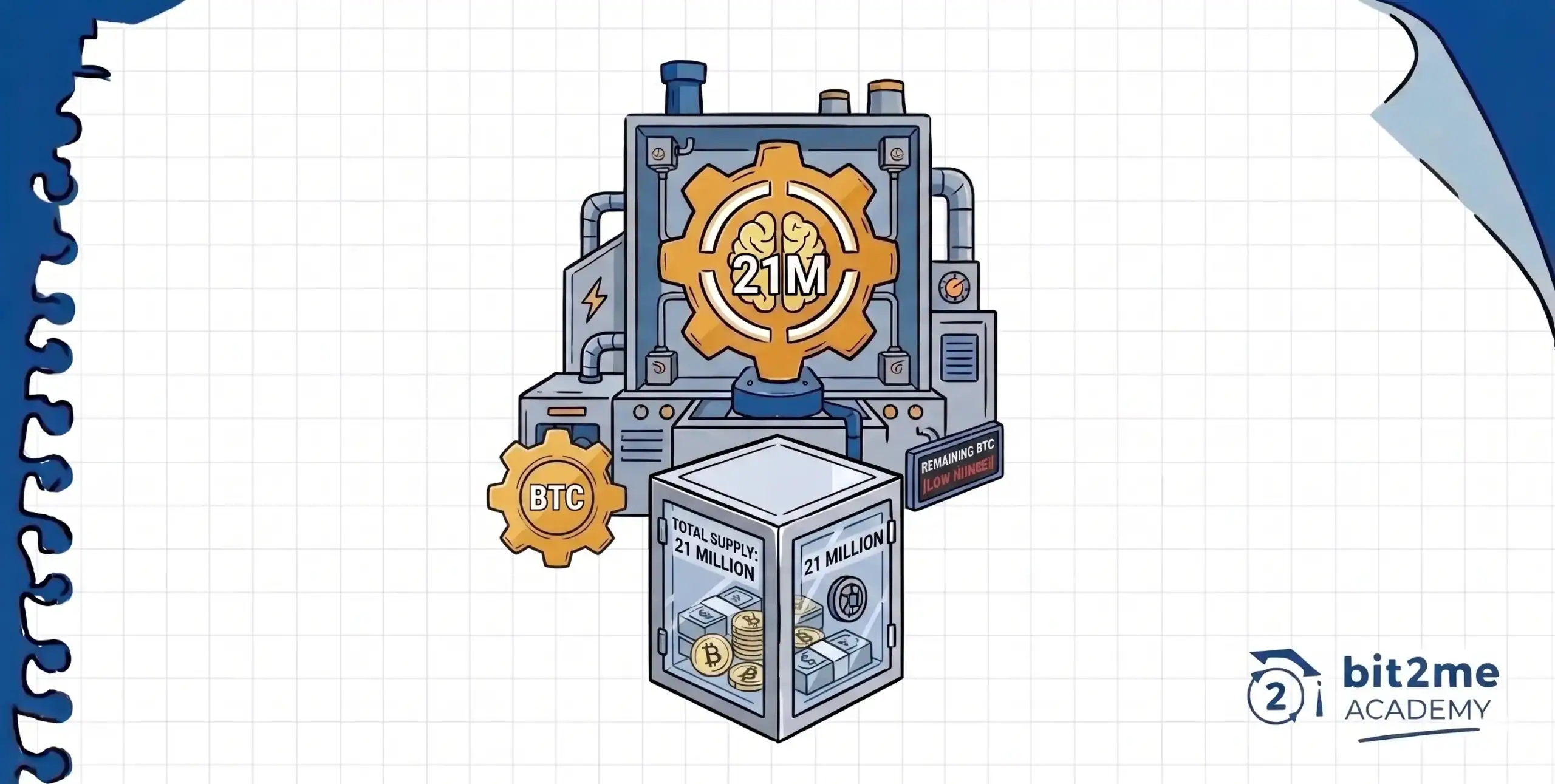
- Programmed scarcity mechanism: The Halving guarantees that the total supply of Bitcoin will never exceed 21 million, radically differentiating it from inflationary fiat money.
- Network sustainability: The reduction in rewards forces miners to optimize their energy and operational efficiency to maintain the profitability of the business.
- Market cycles: This event acts as a psychological and economic catalyst that, historically, precedes bull markets due to the supply shock.
- Security and consensus: The Halving is not a human decision, but an immutable mathematical rule executed by thousands of nodes around the world.
The Bitcoin Halving is a programmed event in the protocol that reduces the issuance of new BTC by 50% every 210.00 blocks (approximately 4 years). It was created to incentivize mining. Proof of Work (PoW).
The first cryptocurrency to implement this process was bitcoin. All this because the amount of bitcoins that may come into existence is finite and is established in the Bitcoin software at 21 million bitcoins. Not one more. Bitcoin software establishes that bitcoins will be released for reward miners as they create blocks validating transactions, at a rate of every 10 minutes on average.
However, the number of bitcoins released is not always the same: the software dictates that every certain number of blocks, the number is halved. This automated process is called halving, and it serves to establish a specific timeframe until the end of coin issuance in order to maintain a stable model. deflationary, or what is the same, to gradually increase its value.
 Certificate

When will the next Bitcoin Halving be?
The next Bitcoin halving is scheduled to occur in the year 2028. This event occurs every 210.000 blocks mined, which typically takes about four years. During the halving, the block reward for Bitcoin miners is cut in half, meaning fewer new Bitcoin coins are issued into circulation.
This process is designed to control the supply of Bitcoin and prevent inflation, as it limits the number of new coins that can be produced. The Bitcoin halving has historically been a catalyst for significant increases in Bitcoin's price, making it a highly anticipated event for the cryptocurrency community.

Emission limitation
Halving is a mechanism created so that cryptocurrencies such as bitcoin are not immediately distributed. To achieve this, this scaling mechanism was established to control the emission.
This issuance generates that there are new cryptocurrencies in circulation and we can buying bitcoins easily. A predictable process of initial democratization for the distribution of the currency that gives the opportunity to prevent all of them from ending up in a few hands. Satoshi Nakamoto, who devised the mechanism in Bitcoin said the following:
The constant addition of a fixed amount of new coins is analogous to that of gold miners who spend resources to add gold to circulation. In our case, it is the CPU time and electricity that is spent
90% of all BTC have already been mined
In this way, if we look at the evolution of Bitcoin up to the present, we see that we have reached the figure of practically 90% of the bitcoins in circulation. We must bear in mind that with the first 210.000 blocks the figure of 50% of the bitcoins in circulation was reached.
Within this period in which we are, 2.625.000 BTC will be added, which will mean reaching 18.375.000 BTC and we will reach the amount of BTC in circulation of 87.5%.


What would have happened without halving in Bitcoin?
Without the halving process, all bitcoins would have been mined long ago. Therefore, miners will only receive transaction fees as compensation. These fees are practically worthless, since Bitcoin wouldn't have had time to appreciate enough to make mining profitable.
It would have taken us a few years for all the bitcoins to be in circulation. Initially, 50 BTC were distributed per block, which equates to 300 bitcoins per hour or 7200 bitcoins per day.
Annually, 2.628.000 bitcoins would be released, which, if we divide that by the total possible number of bitcoins, which is 21.000.000, gives us almost eight years the time it would have taken to put all the bitcoins into circulation.
Projection of added bitcoins in the short term
The table that can be seen below establishes the percentage of bitcoins in circulation with respect to the total and the date on which said figure was reached. We can also see how many bitcoins the period opens with and how many it closes with, as well as the amount added.
All the halving
The calculations of all the halving are done and it is known how many bitcoins will be awarded for each block from its beginning until the last one is mined. We are currently in the fourth of thirty-four halving stages. The fifth era will begin in 2024.
The last halving will already establish a zero reward or, what is the same, the miners will only charge the commissions for the transactions that are made. This will happen in block 6.930.000, which according to calculations will be in the year 2140.

As you can see, in the sixth halving the reward for each block will be less than 0,8 BTC. Currently, each block is rewarded with 6,25 BTC (in 2024 it will drop to 3,125), so some believe that by 2032 a single bitcoin could be worth at least €200.000.
And we can clearly see that in the following graph where we see the halving and the price evolution of Bitcoin.

What does the bitcoin halving?
Halving will be executed automatically. As established in the code, so there will be no break in the network or anything like that. Everything will continue as before. Except that, from that moment on, for each block mined half of BTC will be issued to the world.
Consequences for a normal user
For anyone who uses bitcoin in their day to day, when making transactions or sending money around the world, there will be no consequences. You will be able to continue using your wallet as normal and as you have done up to now.
Consequences for a bitcoin miner
Miners are more important players in this case. A few days after the halving it can be seen if the same computing power is maintained while mining on the network or if a part of the miners will stop mining due to the high cost and little reward (assuming that the price of a bitcoin does not rise in price). . Taking into account that every 10 minutes they will receive 50% less bitcoins, the research and the path towards more efficient miners could be increasing.
Consequences for speculators
For speculators, a halving can be a perfect time to start trading. raise the price of bitcoin, because the new reward will make bitcoin increasingly scarce. The issuance of bitcoin is reduced and this leads to demand being greater than supply, thus increasing the price of BTC.
How often does a halving happen?
about every 4 years, although the halving calculation is complex because it is impossible to predict how long it will take to mine a block. Of course, the software can calculate the average time and based on that time constantly adjust the complexity.
There is a mine complexity readjustment every 2016 blocks. This is done to keep the time between each mined block close to 10 minutes.
To simplify our explanation, we've assumed that blocks are always generated every 10 minutes. While this isn't always the case, it's usually very close. Therefore, we'll say that six blocks are generated per hour. This is how 18,75 bitcoins per hour are added to the networkBased on the block reward of 3,125 bitcoins, which has been awarded since April 2024 (Bitcoin's fourth halving), miners can choose to put these new bitcoins on the market when they want to sell them.
To perform the calculation of the halving process we are going to perform a simplified calculation with integers. This is so that the approximate process and deadlines can be understood. We must multiply the 210.000 blocks by 10 minutes (interval between which the blocks are generated). Then divide it by 60 minutes (1 hour = 60 minutes).
Each halving process happens approximately every 35.000 hours, which is equivalent to 1.458 days, that is, 4 years.
Countdown to the next halving in Bitcoin
Surely at this point you will ask yourself: How long until the next Bitcoin halving? Below we give you the days and the date:
FAQ - What is the Bitcoin halving, when does it happen, and what does it do?



 Author