Essential Points
- Efficiency as the standard: The move from Proof of Work to Proof of Stake is not just a technical improvement, but a sustainability necessity that reduces the environmental impact of blockchain by more than 99%.
- Democratization of consensus: Unlike traditional mining that requires expensive hardware (ASICs), PoS allows any asset holder to participate in network security through staking.
- Economic security vs. computational security: Network integrity does not depend on brute force, but on aligned incentives; validators risk their own capital (slashing) against malicious behavior.
- Scalability vector: By eliminating the competition to solve mathematical puzzles, PoS facilitates faster block times and a higher transaction processing capacity per second (TPS).
The Participation Test, is one of the two most widely used consensus protocols in blockchain technology. His name in English is Proof of Stake. From there derive the acronym PoS, with which it is known. The objective of this algorithm, as in PoW, is to create consent between all the parts that make up the network.
You can review the differences and similarities between both protocols in this comprehensive PoW vs PoS comparison.
At nodes. who work in PoS are called validators. The decision on which node to validate a block it is done randomly, but giving greater probability to those who meet a series of criteria. Among these criteria we can mention the amount of reserved currency and the time of participation in the network, but others can be defined.
Once established, the node selection process starts randomly and when it ends, the chosen nodes will be able to validate transactions or create new blocks.
This shows that Proof of Stake is a process completely different from the well-known Proof of Work (PoW) protocol. Where each of its nodes do hard computational work to solve cryptographic puzzles. Unlike PoW, which requires large amounts of energy and specialized equipment to carry out its operations, PoS is a much simpler and energy-friendly process. For this reason, many blockchain projects are interested in this new protocol.
The first currency to use this protocol was Peercoin in 2012. Then others appeared like NXT y Bitshares who also use this protocol.
Why was the Proof of Participation created?
The Proof of Stake protocol was created by the renowned developer Sunny king, in 2011. In 2012, King formally introduced the whitepaper de the ppco, where he made it clear how the PoS algorithm worked. The objective was to solve some known PoW protocol problems. Among them are the following:
- Lack of scalability and speed. The marketing process includesseveral phases that are reflected below: mining is. adds a high level of latency to be able to approve transactions and produce new blocks. However, PoS avoids this situation. In PoS blockchains, verifications are performed by nodes with high coin holdings. In this way, the verifications are done quickly, positively impacting the scalability and speed of the network.
- The high energy consumption of the mining process. The mining process in PoW requires a lot of computing power, which generally comes from machines with high electricity consumption. PoS changes the mining process to a participation process reflected in the holding of coins or in the time within the network.
- The decentralization of the network. This is a problem that affects PoW networks and that is becoming more and more palpable when looking at large mining pools. A situation that centralizes the network in the hands of a few. PoS seeks to solve this, diversifying and democratizing the access to the participants in the different tasks of the network.
- Subtract financial interest from 51% attacks. The 51% attacks, are one of the concurrent fears in PoW networks. It is enough for a malicious mining group to have 51% of the computing power of the network for the disaster. Well, with that capacity, the mining group can manipulate the blockchain at will. But in a PoS system, this is only possible if the attacker owns 51% of all coins. If the attacker makes such an attack, the value of the coin tends to drop. Which leads to very large economic losses for the attacker. This situation serves as a deterrent to prevent these attacks, while maintaining network security.

How does the Proof of Participation work?
The operation of the Proof of Stake protocol is quite particular.
This system looks for incentivize participants to have a certain amount of coins at all times. This allows them to be chosen by the random selection process that is carried out to designate tasks. Under this scheme, those who have more reserves have greater weight in the network and greater opportunities to be chosen. Once chosen, web3 or wa can validate transactions and create new blocks within the network. Allowing them to receive earnings and incentives for the work done.
PoS protocol example
A simpler way to explain this process would be the following example:
Imagine that you are part of a network of 100 investors. From that network, a first group of 50 investors own 1,000 coins each. Another group of 30 investors, hold 2,500 coins each. And a last group of 20 investors, they own 10,000 coins each. In the following table, you can see the data of each of the mentioned groups and their weight of participation in the network.
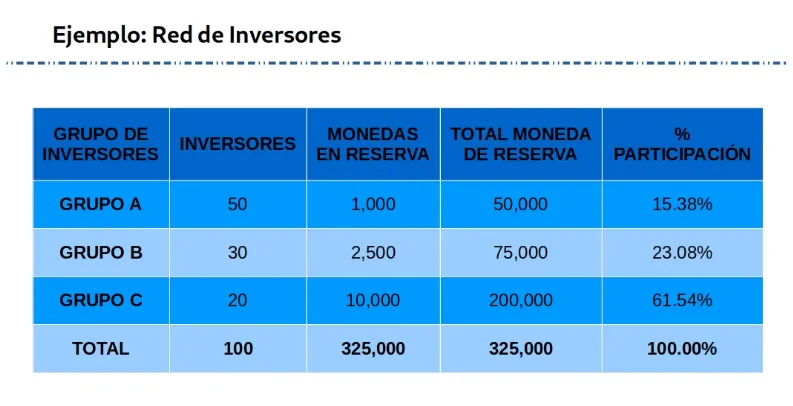
Thus, it is clearly seen that the Group C, He is the one who has the largest participation in the network A total of 61,54% and 200.000 coins to be exact. Now, it is time to carry out the process of random selection in the network. This means that those who are in Group C are more likely to be selected. But not only they are selected. Members of the Groups A y B. This is done in order to democratize and decentralize the network.
Greater tenure does not guarantee selection as a node, but it does provide greater opportunities. With this, it is sought that all those who are within the network benefit without suffering discrimination. In addition, any of the investors in Groups A and B can invest more to increase their level of participation.
Once selected, investors have the ability to perform the tasks that they are allowed. Investors perform these tasks in order to receive incentives and earnings proportional to their participation in the system. After the round, the selection process is restarted so that other investors can participate.
In addition to this, funds used as holdings cannot be used and must be locked within the blockchain. In this way, it is guaranteed that the funds will always be available as collateral for the validator node. However, the node you can add new funds at any time, in order to further increase their level of participation.
PoS Features
The Proof of Stake (PoS) protocol has a wide variety and powerful features, among which we can mention:
- It is a technology more respectful with the environment. This is thanks to the fact that it does not need powerful machines for mining activities. Which means that its energy consumption is reduced.
- It allows a better alignment of objectives and incentives among the members of the network. In this way, each of those who are part of the network seek to maintain said network for a long period of time.
- It improves decentralization and democratizes access to the network. This thanks to the fact that everyone can participate in the network, as long as they meet their participation quota. In PoS networks, the concepts of mining and the equipment that this task entails do not apply. What avoids the concentration of power in a few hands due to how expensive their activity may be.
- The delivery of rewards is more proportional. Due to the random selection system within the network, which is intended to assign tasks to those who have coin possession. Those who have more possession have a greater chance of being chosen, of making verifications and receiving profits with it.
- Network security is much higher. Since it solves or hinders certain attack schemes already known, such as the 51% attack.
- Offers greater scalability. This is used as one of its main characteristics. The speed and scalability of PoS networks far exceeds PoW networks, as it does not require any intensive computational work that consumes a large amount of time. This makes PoS perfect for any blockchain that wants to be used as a retail payment system, where large numbers of transactions are required to be verified per second.
- There is the risk of losing funds due to malicious attacks. PoS systems require that the user's wallet is always open and connected to the Internet. This creates a security issue that can allow hackers to exploit vulnerabilities to steal funds from such wallets. One more reason to follow common security criteria when using this system.
Featured Blockchains with Proof of Stake (PoS)
The Proof of Stake (PoS) model has been adopted by numerous renowned blockchains, driving innovation and efficiency in the sector. Below, we highlight some of the most influential:
Ethereum (ETH)
After a long and detailed development process, Ethereum completed its transition from Proof of Work (PoW) to Proof of Stake (PoS) with the update «The Merge» in September 2022. This historic shift positioned Ethereum as the leading blockchain to migrate to PoS, with the goal of dramatically improving its scalability, reducing its energy consumption by over 99%, and laying the groundwork for future improvements. Ethereum validators must stake 32 ETH to run a validator node and participate in network security, receiving rewards for doing so.
Cardano (ADA)
Cardano Cardano is a pioneering blockchain in the use of PoS, having developed its own protocol called Ouroboros. Ouroboros is an academically validated and peer-reviewed PoS protocol, distinguished by its focus on security, sustainability, and interoperability. On Cardano, ADA holders can delegate their tokens to a stake pool managed by others or run their own pool, thereby participating in consensus and receiving rewards.
Left (LEFT)
Solana Solana uses a sophisticated model that combines Proof of Stake (PoS) with Proof of History (PoH). PoH is a cryptographic construct that provides a way to certify the passage of time between events, allowing for more efficient transaction validation. This combination allows Solana to achieve extremely high transaction speeds and low fees, making it a strong contender in decentralized applications (dApps) and DeFi. Validators on Solana must stake SOL to participate in the network.
Polka dots (DOT)
Polkadot It uses a PoS consensus mechanism called GRANDPA/BABE. Its parachain architecture allows multiple specialized blockchains (parachains) to run in parallel, connected to a main chain (Relay Chain). The security of the entire Polkadot network is maintained through PoS consensus on the Relay Chain, where validators secure the chain and participate in validating parachain blocks. DOT holders can stake their tokens to become validators or delegate to other validators.
These blockchains, among many others, demonstrate the versatility and power of Proof of Stake (PoS) as a consensus protocol, offering clear paths toward greater scalability, sustainability, and efficiency in the blockchain world.
The Future of PoS: Innovations and Challenges
Proof of Stake (PoS) is not a static protocol; it continues to evolve with innovations that seek to improve its efficiency, security, and decentralization. One of the most significant areas of development is the optimization of validator selection and reward management. Various staking algorithms and models (from direct delegation to professionally managed pools) are being explored to improve stake distribution and mitigate potential centralization points.
Another crucial aspect is improving security. While PoS offers inherent advantages against certain types of attacks, ongoing research is focused on strengthening resilience against slashing attacks (penalizing validators for misbehavior) and ensuring the robustness of protocol code. The emergence of "liquid" PoS (liquid staking), which allows users to earn a token representing their stake and use it in other DeFi applications while continuing to generate rewards, adds a layer of complexity but also utility and liquidity to the ecosystem.
Despite its advantages, challenges remain. Initializing and maintaining a significant stake can be a barrier to entry for some users, although delegated staking solutions and pools seek to mitigate this obstacle. Ensuring that the PoS model promotes genuine decentralization and does not lead to a new form of power concentration (this time, through capital accumulation) remains a key goal for the community.
The path to a more scalable and sustainable future for blockchains is intrinsically linked to the success and continued improvement of protocols like Proof of Stake. As more networks adopt and refine these mechanisms, we're likely to see a more efficient, accessible, and environmentally friendly blockchain ecosystem.
FAQ – What is Proof of Stake (PoS)?



 Author