Essential Points
- Buying a stock makes you the owner of a company; buying an ETF makes you the owner of a piece of hundreds of companies at once.
- An ETF automatically spreads your money across many assets, whereas replicating that with individual stocks requires time and capital.
- It helps resolve the typical doubt of the novice investor: if you already know both instruments, this helps you decide which one to start with.
- Neither of them is "the good one": the most expensive mistake is believing that having five well-known companies is already true diversification.
At some point, anyone who starts to become interested in the world of investing asks themselves the same question: why not just buy shares of the companies I know directly, instead of getting into something called an ETF?
If you already know what each asset is individually, the next logical step is to compare them side-by-side to decide which one to start your portfolio with. This isn't a trivial question: the decision you make now will determine how much risk you take, how much time you'll have to dedicate to it, and how long it will take to build something resembling a balanced portfolio.
In this article, we compare ETFs and individual stocks using objective criteria, without dismissing either option. You'll see exactly what you're buying in each case, the clearest advantages of ETFs over selecting individual stocks, when buying individual stocks still makes sense, and the diversification mistake that almost every beginner makes. Finally, we'll tell you how. Bit2Me Invest It gives you access to both worlds from the same account.
ETFs vs. Stocks: What exactly are you buying in each case?
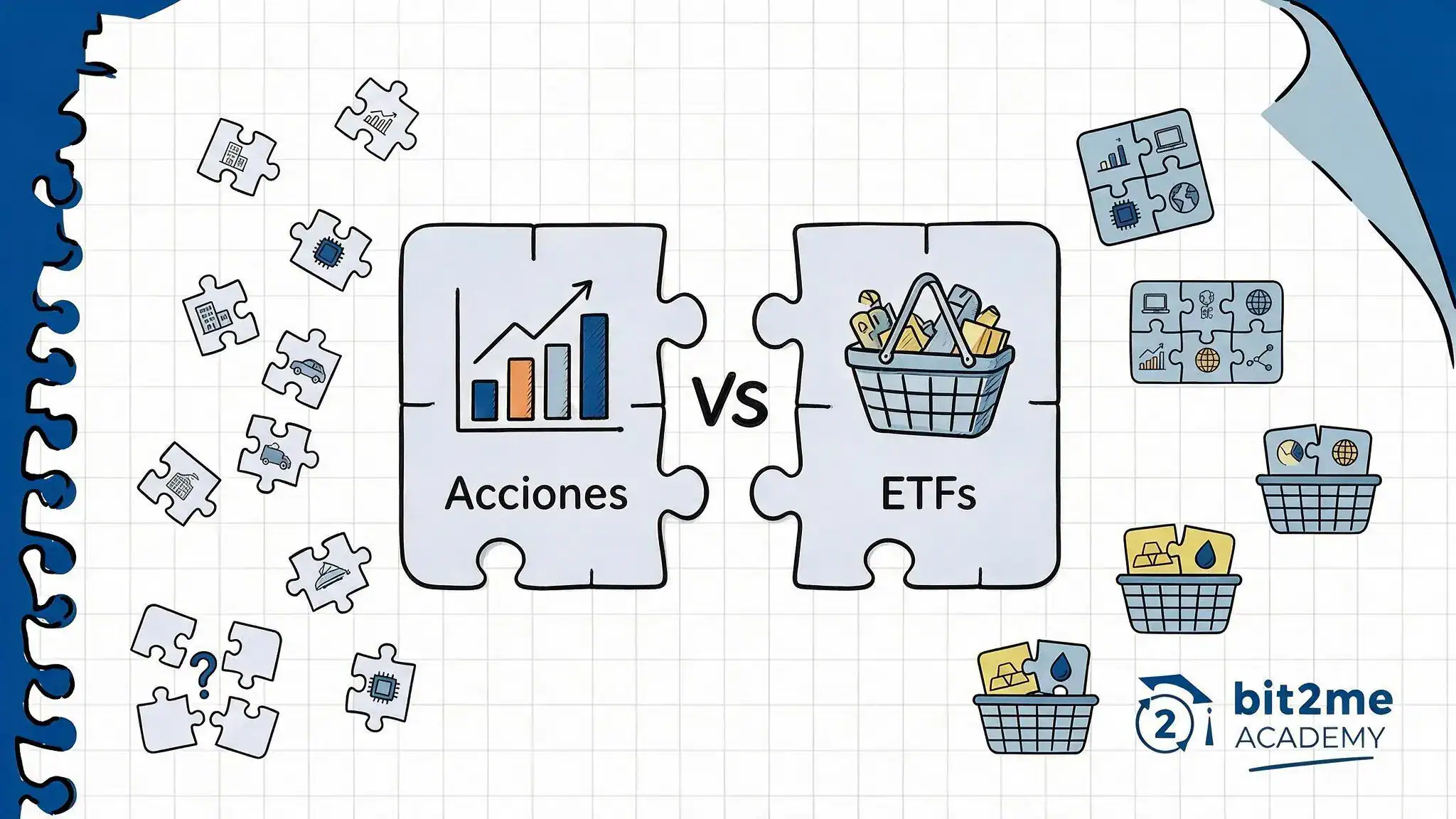
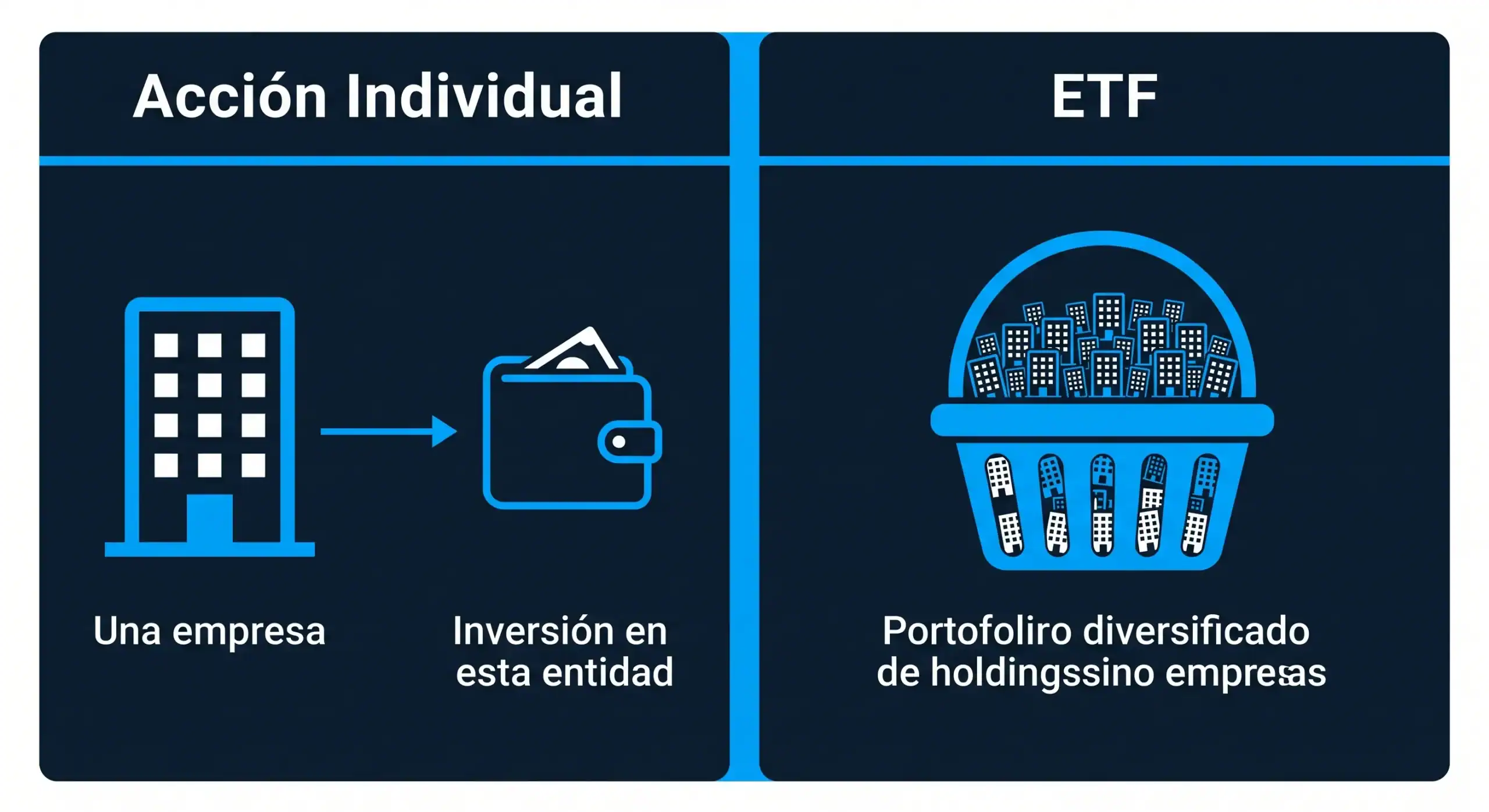
Before discussing advantages or disadvantages, it's important to understand the conceptual difference between these two instruments. When you buy a share, you acquire a real stake, however small, in a specific company. If you buy a share of Inditex, you become a co-owner of Inditex in the exact proportion that your investment represents, with the right to what corresponds to that part of the business.
An ETF (exchange-traded fund) works differently: it's a basket that groups many different assets within a single product. If you buy an ETF that tracks the IBEX 35, in a single transaction you acquire a proportional share of the 35 largest Spanish companies, without having to buy each share separately. The same applies to global ETFs, which can provide exposure to thousands of companies in dozens of different countries.
An analogy helps to illustrate the point: buying a share of Apple is like buying a puzzle piece (for illustrative purposes only, not as a buy recommendation). Buying an S&P 500 ETF is like buying the entire 500-piece puzzle all at once. Would you rather have a perfect piece or the whole puzzle assembled from day one?
The practical consequence of this difference is enormous for beginners. With an ETF, from the very first euro you're diversified across dozens or even hundreds of companies. With individual stocks, you need enough capital to buy several companies and, above all, time to analyze them one by one before making a decision. If you want to review the concept from scratch, we have a complete guide dedicated to it. What is an ETF?And if you're looking to better understand the other side of the comparison, you can also consult our article on What is a stock?.
The 5 key advantages of ETFs over individual stocks
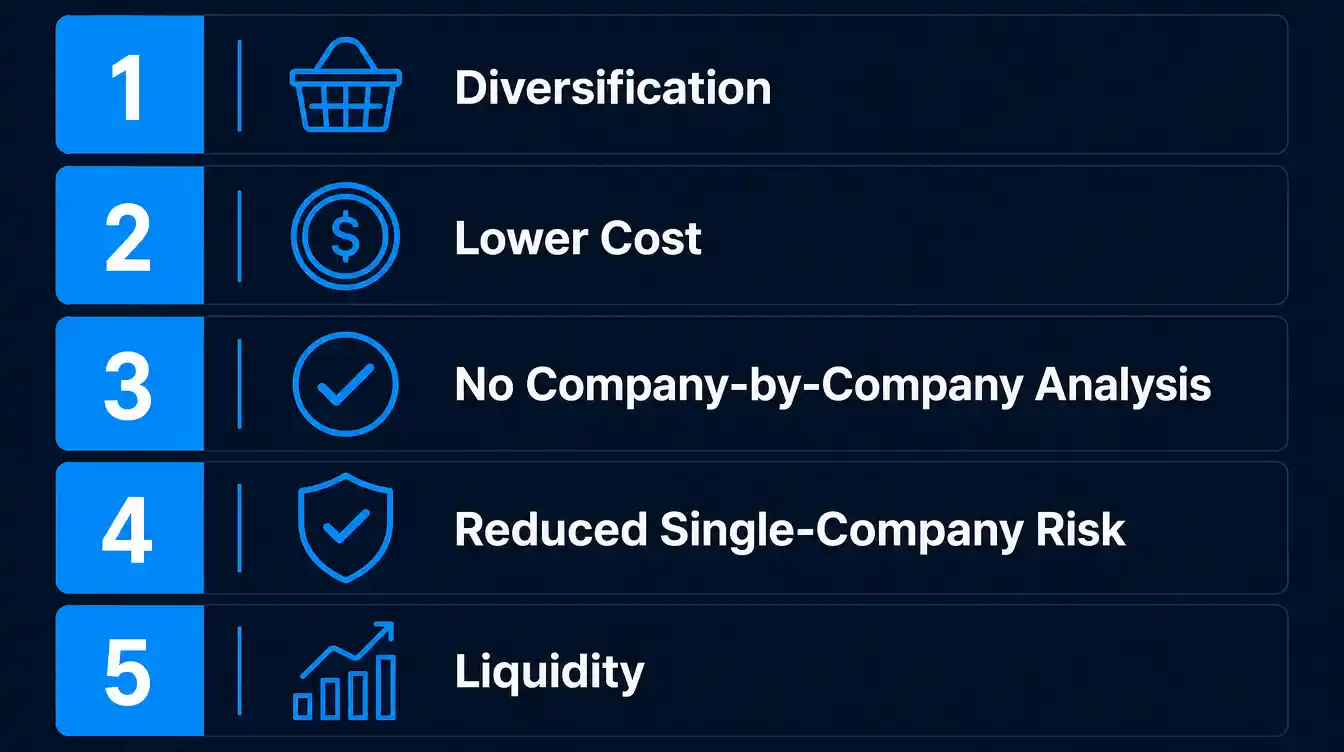
Having understood the conceptual difference, the question then arises: why do so many novice investors start their portfolios with ETFs instead of individual stocks? Here are the five advantages that most influence that decision.
- Instant diversification from the first euro. With a single global ETF, you can gain exposure to thousands of companies spread across dozens of countries and sectors. Replicating something similar by buying individual stocks would require acquiring at least 20 to 30 carefully selected stocks from uncorrelated sectors, which demands considerable capital and analysis.
- Lower total operating cost. Index ETFs typically have significantly lower management fees than traditional actively managed funds, although the exact percentage varies depending on the index, the provider, and market conditions. With individual stocks, in addition to the commission on each purchase, you usually pay for each dividend received and, if you invest in international markets, for currency conversion.
- Without needing to analyze company by company. A passive ETF automatically replicates the composition of its benchmark index, so you don't have to read quarterly earnings reports or keep track of every corporate announcement. With individual stocks, actively managing a portfolio requires real dedication, or paying someone to do it for you.
- The risk of a specific company has little weight in the overall picture. If a company within a broad index like the S&P 500 experiences serious difficulties, its relative weight in the ETF is so small that the impact on your portfolio is marginal. However, if that same company is one of the five holdings in your stock portfolio, the blow can be much harder to absorb.
- Transparency and liquidity in real time. ETFs are traded on stock exchanges just like stocks, meaning you can check their price and composition at any time during market hours. You can buy or sell them as quickly as any stock, without the redemption periods typical of other investment vehicles.
Historically, passive index investing has tended to outperform active investing in the long term, although this performance is not guaranteed. Returns shown are net of management and custody fees. Past performance is not indicative of future results: the value of your investment may go up or down.
 Certificate
When might individual stocks make sense compared to an ETF?
None of the above means that buying individual stocks is a mistake. For some investors, it makes perfect sense: people with in-depth knowledge of one or more specific sectors, real-time access to corporate news, and enough emotional tolerance to manage the volatility of an individual company without making rash decisions.
For some investors, selecting companies is also an intellectually stimulating activity in itself. Analyzing annual reports, following industry strategies, or understanding why a company is gaining market share against its competitors can be just as interesting as the returns themselves. If this describes you, individual stocks add a component of personal involvement that an ETF, by its very automated nature, cannot offer.
The key to deciding is being honest about the actual time you can dedicate. If you can't dedicate several hours a week to seriously analyzing companies, passive management with ETFs tends to statistically outperform active stock picking in the long run, according to available historical evidence. That doesn't make stock picking a mistake; it makes it a more demanding strategy with a higher concentration risk, not a worse option by definition.
The important thing is to choose with your eyes open. Buying individual stocks without the necessary time or knowledge isn't "daring to invest better": it's taking on a concentration risk you may not have calculated. And buying only ETFs without ever considering a specific stock isn't necessarily the only way either; it's simply the one that statistically requires the least amount of your time.
ETFs vs stocks: the most common mistake beginners make
There's a mistake that almost everyone who starts investing on their own makes: believing that buying five or ten well-known companies already constitutes diversification. It's easy to fall into this trap. The reasoning sounds logical: "I have Apple, Microsoft, Nvidia, Amazon, and Tesla; those are five different companies, so I'm diversified" (all of them cited for illustrative purposes, not as a buy recommendation).
The problem is that these five companies are, in fact, US tech companies with a very high correlation between them. When the tech sector goes through a rough patch, as happened notably in 2022, most of them fall together and in the same direction. Having five different names in your portfolio offers no protection if they all represent the same type of risk.
Behind this mistake often lies the so-called familiarity bias: we tend to buy shares in companies we know, whether because we use their products, because they constantly appear in the news, or because they are from our own country. This bias produces concentration, not real diversification, even though the subjective feeling is just the opposite.
An ETF that tracks a broad index, such as a global equity index, includes companies from the technology, healthcare, consumer goods, financial, and energy sectors, spread across the United States, Europe, Japan, and other markets. This combination does generate a lower real correlation between the different components of the portfolio. True diversification isn't about having many names in your portfolio; it's about having assets that don't all move in the same direction at the same time.
What if I combine the two? The core-satellite strategy
Between choosing only ETFs or only stocks, there is a third option widely used by more experienced investors: the core-satellite strategy. This involves allocating a majority of the portfolio to global ETFs, which act as a diversified and stable core, and reserving a minority portion for high-conviction stocks or sector ETFs, which function as satellites.
A typical guideline is roughly 80% in a global ETF and 20% in stocks from sectors the investor knows particularly well. The exact percentage isn't a universal formula: it depends on each person's risk profile, time horizon, and objectives. If you'd like to delve deeper into the various ETFs available to build that core portfolio, we have a dedicated article on them. types of ETFs that exist according to their composition and their geographical scope.
Why does this approach work? The diversified core ensures a solid foundation and reduces the risk of a single selection error ruining the entire portfolio. The satellite holdings, meanwhile, allow you to express conviction in specific sectors or companies without jeopardizing your overall wealth if that investment doesn't perform as expected.
This example is for guidance only and does not constitute personalized investment advice. The appropriate combination depends on your financial situation, time horizon, and risk tolerance. Bit2Me Invest, the suitability test helps determine which combination best fits your specific profile. Know your investor profile Before deciding how to allocate your portfolio between core and satellite holdings; if you also want to better understand how it's calculated, we have specific content on the risk profile of the investor.

Frequently Asked Questions about ETFs and Stocks



 Author