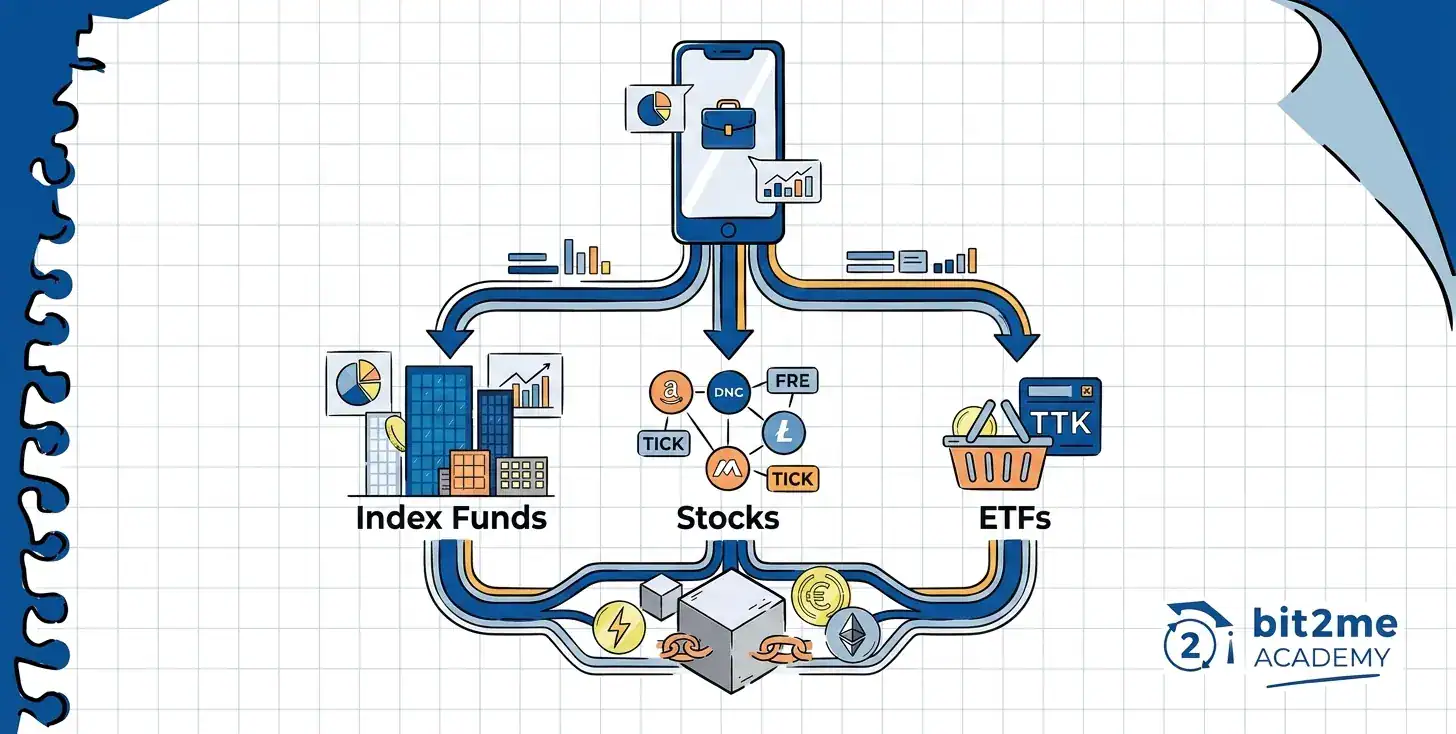
Essential Points
- Index funds, stocks, and ETFs are three distinct ways to participate in financial markets, each with its own level of diversification, cost, and liquidity.
- You can manage them along with your crypto assets in the same application, although each product responds to a different regulatory framework and its own set of risks.
- They are used to build a diversified portfolio beyond a single asset, adapted to different time horizons and risk profiles.
- The important point: no past result guarantees what will come, so understanding costs and taxes before starting is just as important as choosing the right product.
More and more users who already trade cryptocurrencies or use digital banking are considering the next logical step: diversifying into funds, stocks, and ETFs without abandoning the app they already use to manage their money. It's not about replacing one thing with another, but about expanding their investment horizons with products that have been regulated for decades. National Securities Market Commission (CNMV) and which respond to risk and liquidity logics different from those of a digital asset. This curiosity, more than a fad, reflects a real change in how medium- and long-term savings are understood in Spain.
This guide serves as the starting point for the Invest cluster. Bit2Me AcademyHere we explain what index funds, stocks, and ETFs are, why investing in index funds and other regulated products through a single application makes sense, how their costs and basic taxation compare, and how to get started. The other guides in this series delve deeper into each specific component, so this article provides the overall overview before we explore the details of each section.
What are index funds, stocks, and ETFs? Key differences
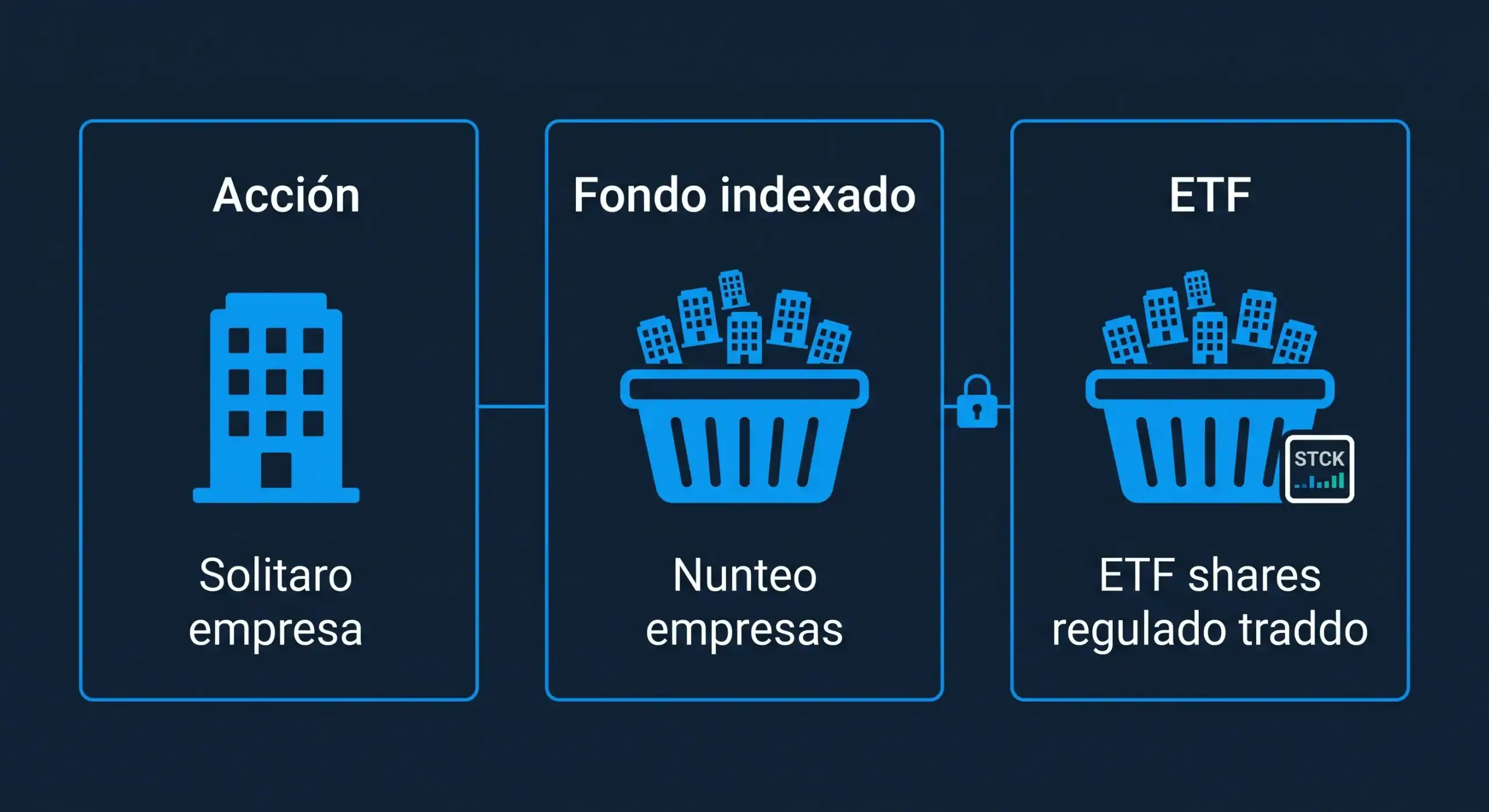
A share is a security that represents a proportional ownership stake in a publicly traded company. When you buy shares of a company online, you become a co-owner of that company in proportion to your investment, with the right to participate in its profits according to the terms and conditions set by the company. The risk and potential return depend almost entirely on the performance of that particular company, making the individual share the product of the three with the least implicit diversification.
An index fund, on the other hand, is a collective investment vehicle that pools money from many investors to replicate the composition of a benchmark index, such as a broad stock market index. Instead of investing in a single company, investors gain access to dozens or even hundreds of different companies at once, spreading the risk across many issuers rather than concentrating it in one. Management is typically passive: the goal is not to beat the index, but to replicate it as closely as possible at the lowest cost.
Un ETF (Exchange Traded Fund) It combines features of the two previous types: like an index fund, it holds a diversified basket of assets that tracks an index, but like a stock, it trades on a stock exchange and can be bought or sold at any time during trading. This dual nature is precisely what distinguishes it from a traditional index fund, whose purchase and sale are executed at a net asset value (NAV) fixed at the close of trading. In upcoming guides to this category, we compare ETFs and index funds in much more detail, because this is often the first real question for beginners.
Why invest in funds, stocks, and ETFs from a single app?
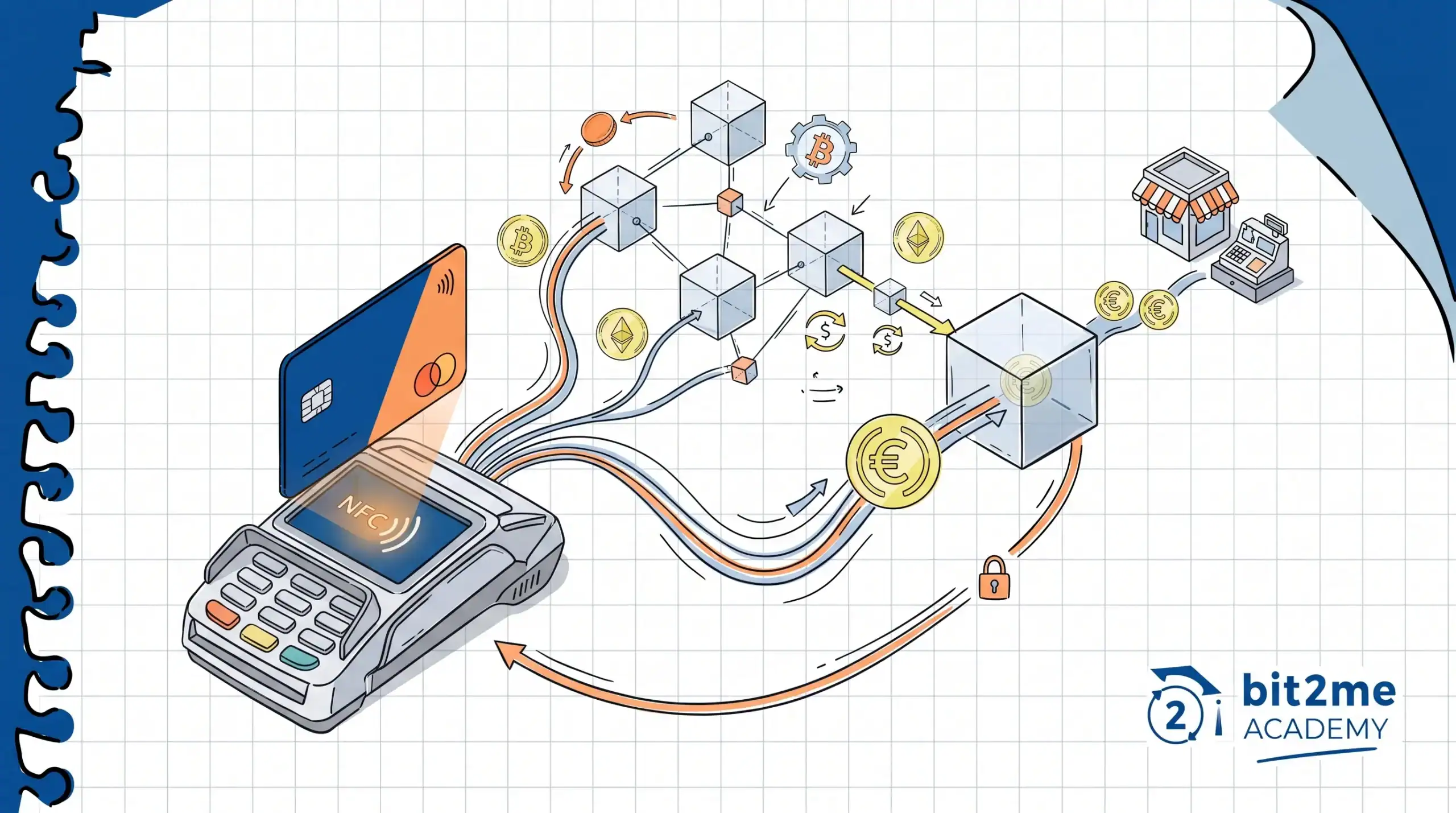
Managing cryptocurrencies, checking accounts, and now also funds, stocks, or ETFs from different applications multiplies the passwords, identity verification forms, and time you spend understanding what you own and where it's located. Consolidating all your financial assets into a single access point doesn't change the nature of each product, but it does simplify tracking: you can see at a glance how much you have in cryptocurrencies and how much in regulated investment products, without having to jump between platforms to get a complete picture of your situation.
It's important to clarify something here that sometimes gets lost in the generic marketing of the sector: adding funds, stocks, and ETFs to an app that already offers crypto assets doesn't mean that both worlds share the same regulatory framework or the same risks. Buying crypto assets is governed by the Regulation (EU) 2023/1114 on markets in crypto-assets (MiCA) The supervision of cryptocurrency service providers falls under the Securities Market Law, while investing in funds, stocks, and ETFs is subject to the CNMV's supervision of investment services. These are two distinct frameworks that coexist within the same application without overlapping, each with its own set of safeguards and risks.
Investment services in funds, stocks and ETFs are provided through Bit2Me Stocks, SL, in collaboration with InbestMeThe entity authorized to manage and execute these operations is responsible for this separation of responsibilities, which is not a minor administrative detail. It determines who is responsible for which operation and under what regulations—something worth understanding before moving the first euro. If you want to see how this translates into practice, you can learn more. Bit2Me Invest and review the catalog of available funds, stocks, and ETFs before making any decisions.
Passive management or active management: What you should know before choosing?
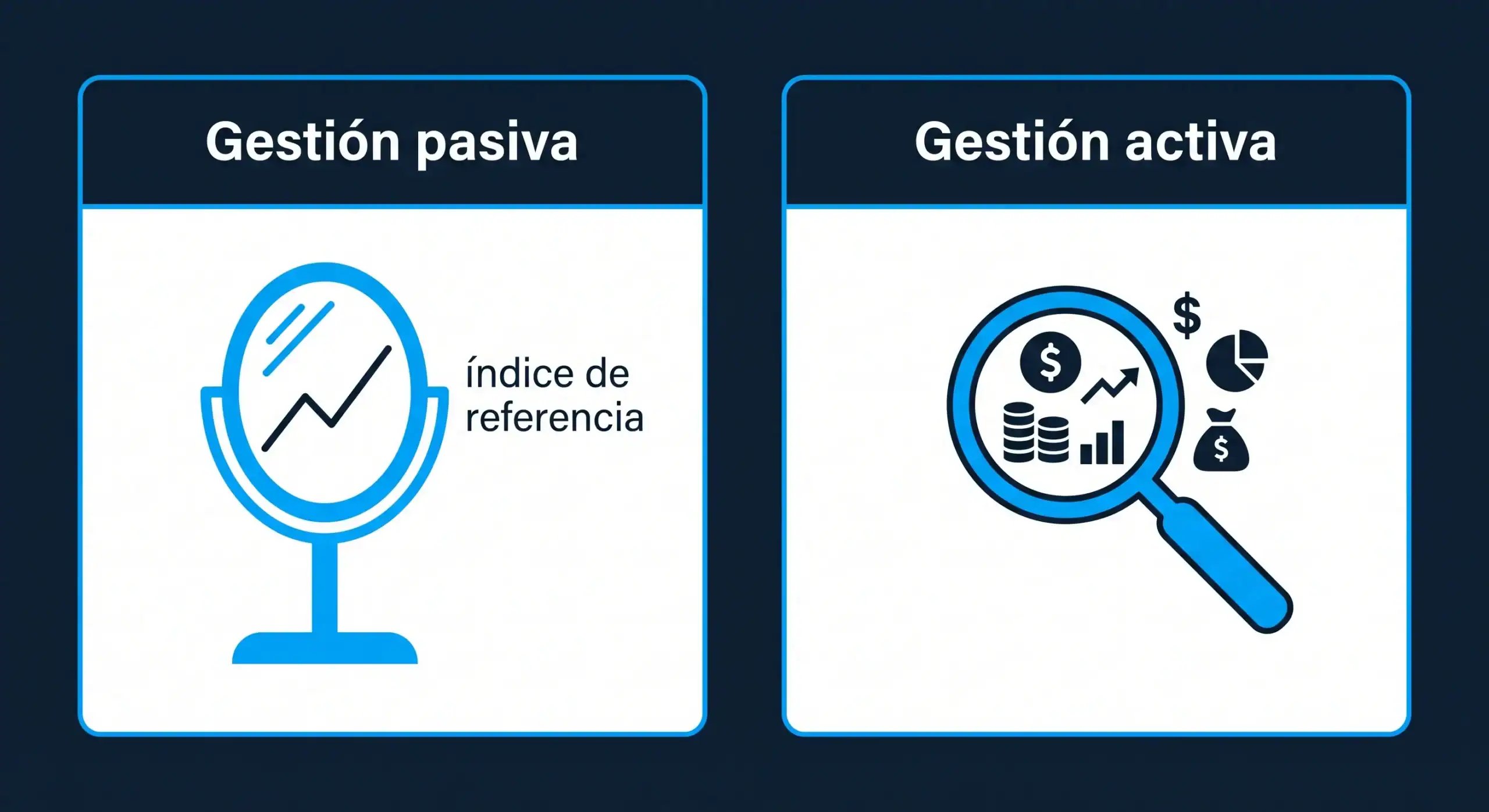
Most of the index funds and ETFs mentioned in this guide follow a passive management approach: the manager's goal is not to predict which assets will rise, but rather to replicate the performance of a benchmark index as closely as possible. This philosophy stems from well-documented evidence in financial literature: consistently outperforming a broad index over several years is difficult even for professional managers, so replicating it at a low cost is often a reasonable alternative for many investor profiles.
Active management, in contrast, seeks precisely that: Outperforming the market through asset selection decisions made by a management team, betting on some companies or sectors over othersThis ambition comes at a cost, almost always in the form of higher management fees than those of an index fund, and a return that may outperform the index in some periods and underperform in others. Neither philosophy is universally better: they depend on the investor's profile, investment horizon, and risk tolerance.
This guide remains at the level of a general overview because the contrast between passive and active management deserves its own section with examples and nuances that cannot be included here. In a specific guide for this cluster, we develop this debate in depth, along with the concept of indexed portfolios and how they are constructed by combining different funds or ETFs according to objective and time horizon.
 Certificate
Costs and fees when investing in index funds, stocks and ETFs
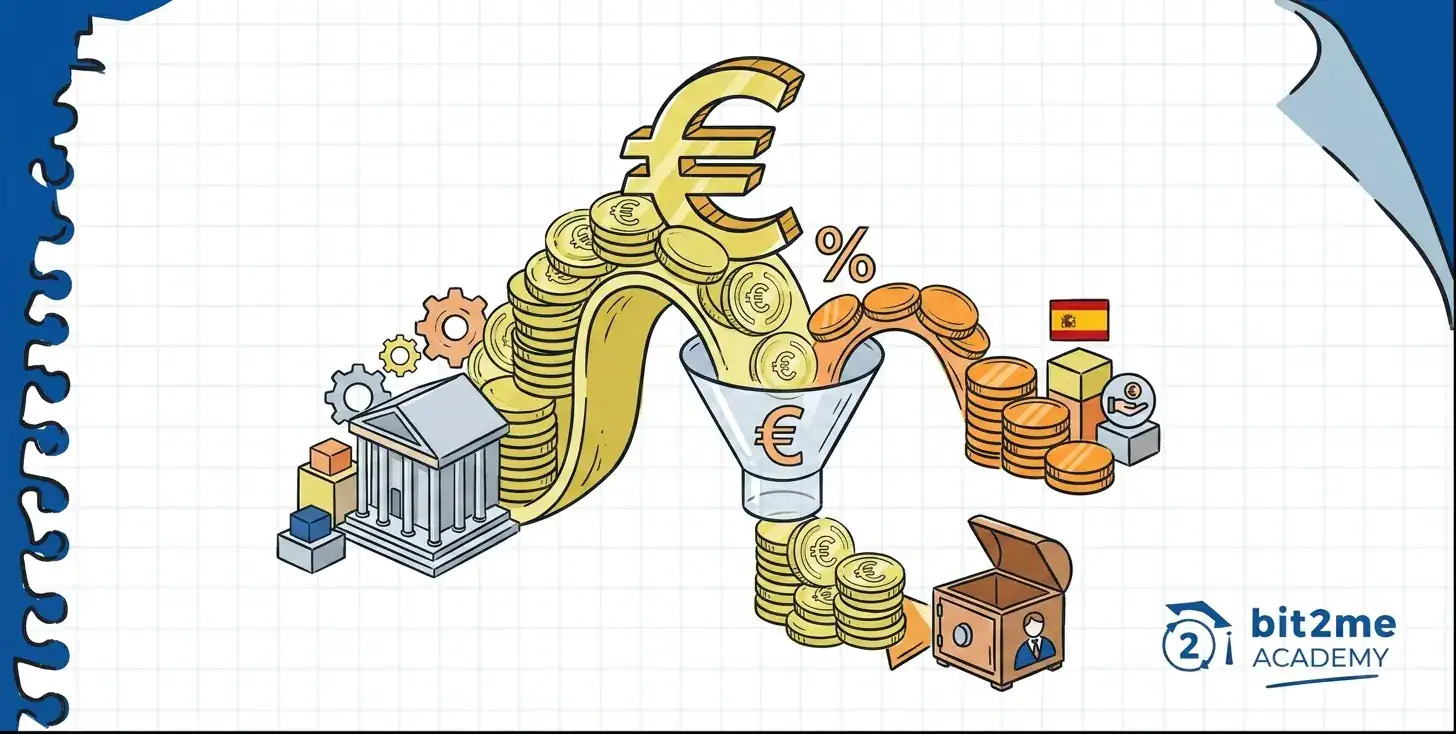
Each of these three products has its own cost structure, and understanding it is just as important as choosing the right asset. Index funds typically charge an annual management fee, commonly known as TER (Total Expense Ratio)This fee is deducted proportionally from the fund's value, so the investor doesn't have to pay it separately. Because it's a passively managed fund, this fee tends to be lower than that of an equivalent actively managed fund, although the exact percentage varies depending on the fund manager and the replicated index.
Buying shares online, on the other hand, involves a brokerage fee for each buy or sell transaction, charged by the broker or platform that executes the order in the market. There is no recurring management fee like with a fund, because there is no manager making daily decisions: the cost is concentrated at the time of trading. ETFs combine both approaches, with a generally low TER similar to that of an index fund, plus the brokerage fee for buying or selling on the market where they are listed.
No single commission figure is stable enough to be cited here without an expiration date, so the practical recommendation is always the same: review the Key Investor Information Sheet (or equivalent document) for each product before investing, where the asset manager or intermediary is required to detail all applicable costs. Comparing this document across different funds, stocks, or ETFs is by far the exercise with the greatest impact on long-term net income, even more so than correctly identifying the latest trendy asset.
Basic taxation of funds, shares and ETFs in Spain
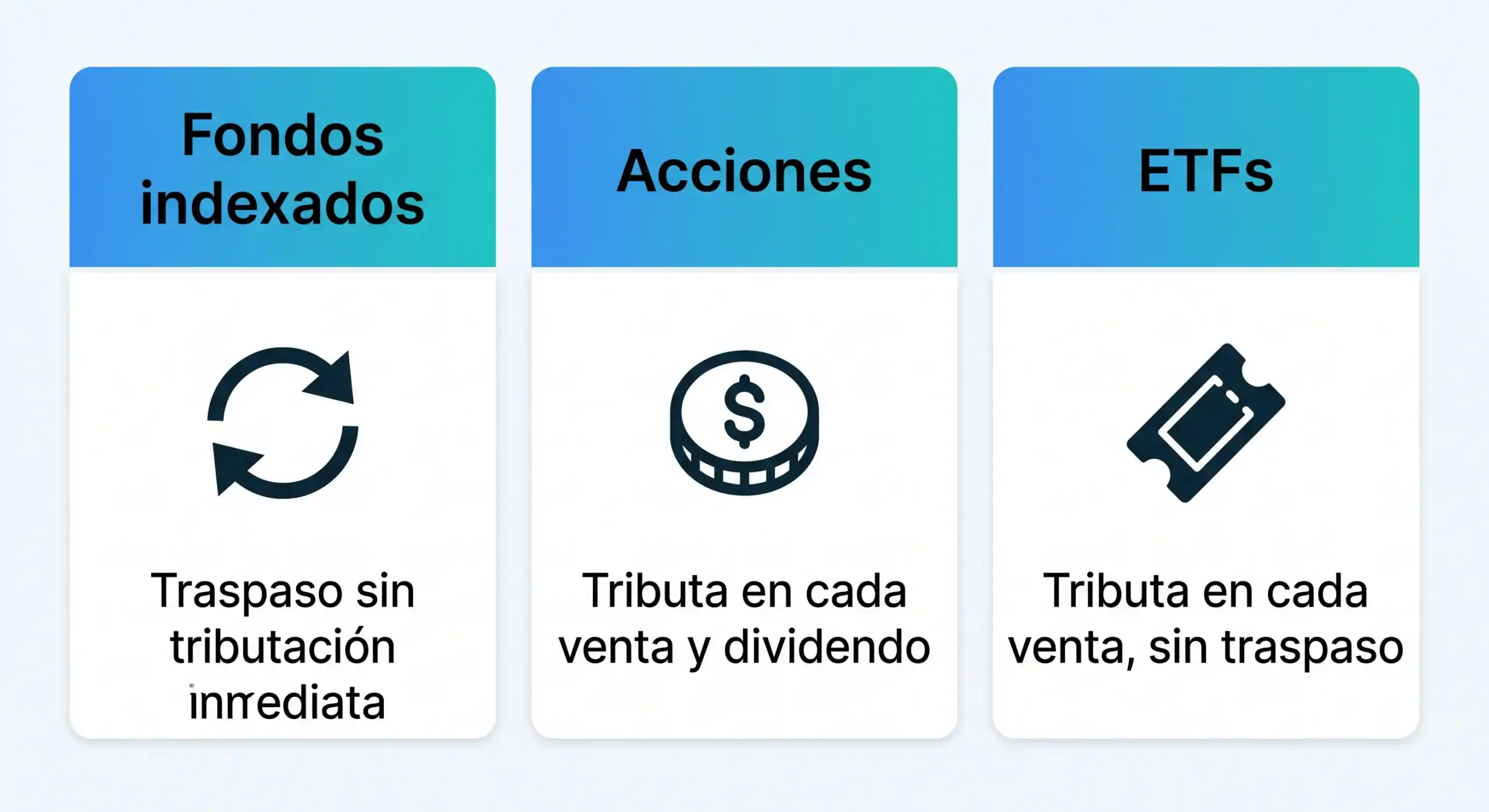
In Spain, the taxation of these three products shares a common framework—the taxation of savings income under the Personal Income Tax (IRPF)—but with important nuances among them. Investment funds, including index funds, benefit from a transfer regime: moving money from one fund to another without going through an intermediate current account does not generally generate immediate taxation, and the gain or loss is deferred until the final redemption. This transfer regime is one of the reasons why many investors use index funds as a long-term accumulation vehicle.
Shares do not have this transfer regime: each sale generates, where applicable, a capital gain or loss subject to the savings tax scale, and dividends received are taxed as investment income in the year they are collected. ETFs, on the other hand, are usually taxed similarly to shares—as a capital gain or loss at the time of sale—and, unlike domestic index funds, most do not allow tax-free transfers under current regulations. This tax difference between index funds and ETFs surprises many users who assumed identical treatment since both are indexed products.
This section is deliberately a basic overview and not a comprehensive tax manual: the regulations have nuances depending on the type of product, the domicile of the fund or ETF, and the taxpayer's personal circumstances, which cannot be fully explained here. In upcoming guides in this series, we will explain in detail how to declare funds and ETFs in the Spanish income tax return, with step-by-step examples. As always with tax matters, this does not constitute tax advice, and it is advisable to consult a qualified professional or the Spanish Tax Agency for each taxpayer's specific situation.
How to start investing in funds, stocks, and ETFs?
The first step, before opening any investment product, is to define the objective and time horizon for the money you're going to allocate: saving for two years is not the same as building wealth for twenty. This time horizon, along with your personal tolerance for portfolio fluctuations, determines which combination of index funds, stocks, and ETFs makes sense for you. Going in reverse order—choosing the latest trend first and then trying to fit it into a specific goal—is one of the most common reasons for decisions you later regret.
With the objective clear, the next practical step is to review the available catalog and compare the information sheet for each fund, stock, or ETF: which index or asset it replicates, what its associated costs are, and what tax treatment applies to it, as seen in the previous sections.From there, the process is simple: select the product, enter the amount, and confirm the order from the same app you use to manage the rest of your finances. In a dedicated guide for this cluster, we detail, step by step and with screenshots, how to start investing in index funds from Spain without common beginner mistakes, and in another guide, we do the same for those who want to buy stocks online from Spain for the first time.
It's worth reiterating two key points already mentioned in this guide, but worth repeating at this final stage: diversifying across funds, stocks, and ETFs doesn't eliminate market risk, it merely spreads it, and past performance is no guarantee of future results for any of these three products. Those already diversifying across cryptocurrencies and other digital assets will find these regulated products an additional layer of diversification with a different risk profile—a topic we explore in more detail in another guide on diversifying between crypto and stocks. And for those who want to understand why time is on the side of those who start early, we also have a guide dedicated to compound interest and its effect on long-term portfolios.

Frequently asked questions about investing in funds, stocks, and ETFs



 Author