In the crypto ecosystem, scalability is one of the biggest challenges facing blockchain networks. Ethereum, in particular, has experienced congestion issues and high gas fees, which has limited its ability to handle a large volume of transactions efficiently. To address these issues, several Layer 2 (L2) solutions have been developed, and one of the most promising is Validium.
Validium is a scalability solution that uses validity tests (such as ZK-SNARKs o ZK-STARKs) to verify transactions off the Ethereum main chain. Unlike ZK-Rollups, which store transaction data on the main chain, Validium keeps this data off-chain, allowing for increased scalability and cost reduction. In this article, we will explore in detail what Validiums are, how they work, their advantages and disadvantages, and how they integrate into the Ethereum ecosystem.
What are Validium?
As we already mentioned, Validium is a Layer 2 scalability technology designed to improve the transaction processing capacity of the Ethereum or compatible networks. Its main goal is to reduce the load on the main chain, allowing for a higher number of transactions per second (TPS) and reducing gas costs.
Validium achieves this by moving transactions off the main chain and using validity proofs (ZKPs) to ensure the integrity of these transactions. Validity proofs are generated by an operator or validator and then verified by a smart contract on the Ethereum main chain. If the proof is valid, the main chain updates its state to reflect the changes made on the child chain.
How do Validiums work?
To understand how Validium works, it is helpful to break down the process into several steps:
Sending transactions
The first stage is the sending of transactions, in which we have two actors:
- Users: Users send their transactions to the Validium operator.
- Operator: The operator collects these transactions and groups them into batches (batches).
In this process, the well-known verification contracts (Verification Contract) and main contract (Main Contract). The purpose of these contracts is to create the user-operator interface that allows for the secure and private use of Validium.
Generating validity tests
At this point, the operator sends the batch of transactions to a proof-of-stake circuit. The proof-of-stake circuit generates a proof of validity (ZK-SNARK or ZK-STARK) that verifies the correctness of the transactions.
State Commitments
Once the proof is generated, the process of committing the network states begins. This involves taking the state of the Validium and storing it in a Merkle tree. The root of this merkle tree (state root) is stored in a smart contract on the Ethereum main chain.
The intention of this is to keep track of the different states of the Validium, so that users and any interested party can verify that the information is correct. This is what allows the traceability and auditability of the Validium.
Status update
Finally, the operator calculates a new state root after executing the transactions. The operator sends the new state root and the validity proof to the smart contract on the main chain. If the validity proof is verified, the smart contract updates the state of the Validium.
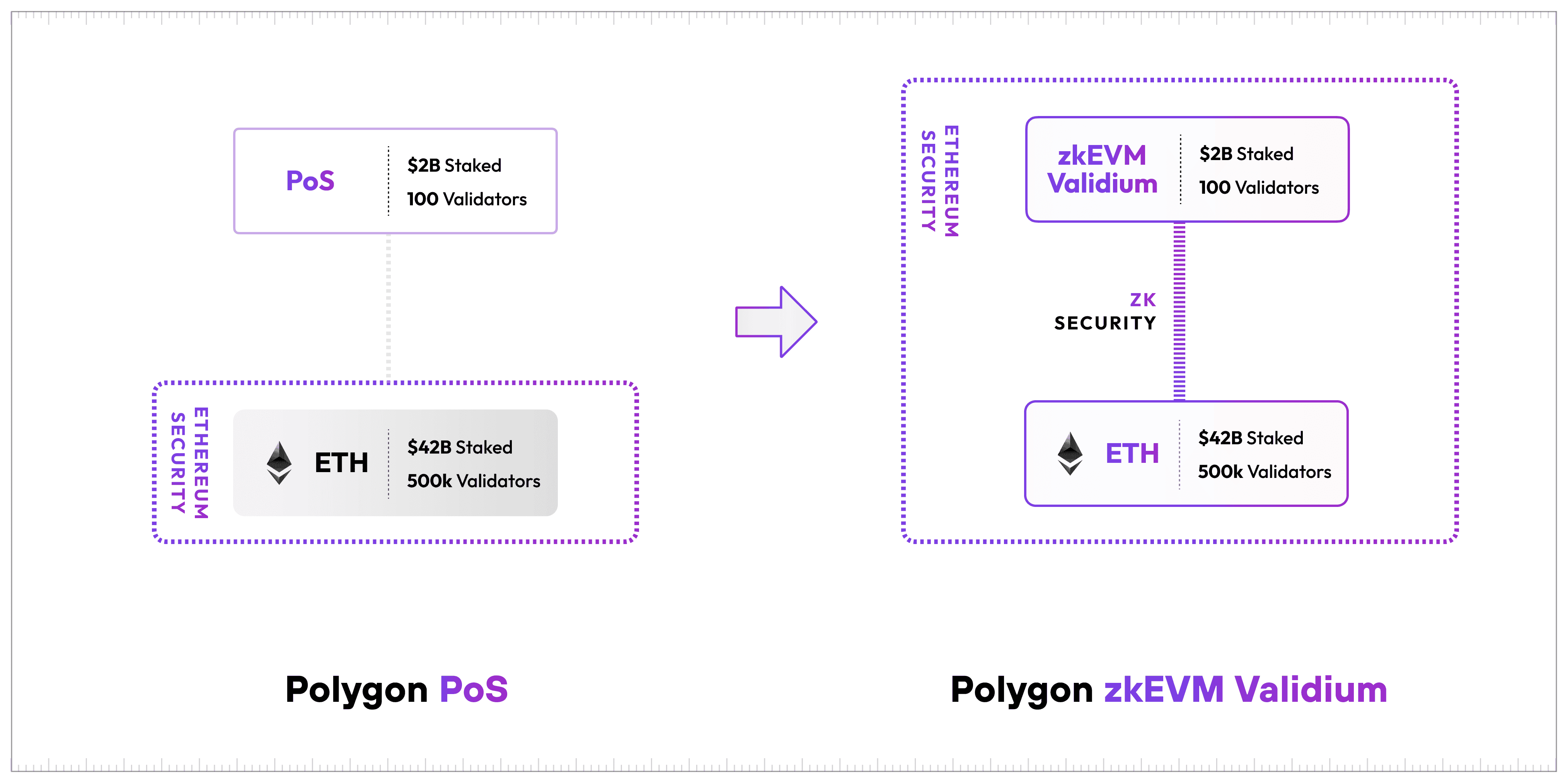
An example of all this operation can be seen in Polygon 2.0, which plans to use a Validium zkEVM for all its operations. In this way, Polygon 2.0 aims to surpass current Layer 2 solutions on Ethereum, such as Arbitrum and Optimistic, in scalability, and to do so, many of the developers have made it known. Advances that we will find in Polygon 2.0.
Advantages and disadvantages of Validium
This way of working with Validium allows the creation of Layer 2s that have a large number of advantages, among which we highlight:
- High TPS: Validiums can process up to 9000 transactions per second, which is significantly more than the 15-25 TPS of the Ethereum main chain.
- Less load on the main chain: By keeping transaction data off-chain, the load on the main chain is reduced, allowing for a higher number of transactions.
- Low gas costs: By reducing the amount of data published to the main chain, gas costs are significantly reduced.
- Capital efficiency: Users can withdraw their funds quickly and without delays, increasing capital efficiency.
- Zero-Knowledge Proofs (ZKP): Zero-knowledge proofs (ZKP) ensure that transactions are valid without revealing sensitive information, improving user privacy.
- Fast transaction confirmation: Transactions on Validium are confirmed quickly, which is ideal for applications that require fast and reliable transactions, such as decentralized exchanges and gaming platforms.
Disadvantages of Validium
Of course, not everything is perfect. Validium also brings some new problems or increases some already known ones. Among these disadvantages we can highlight:
- Operator dependency: Users must trust the operator to process transactions correctly, which can lead to centralization issues.
- Risk of censorship: If the operator acts maliciously, they can censor transactions or freeze funds.
- Data Provider Dependency: Validium relies on data providers to store and provide transaction data. If these providers fail or act maliciously, users may not be able to access their funds.
- Smart Contract Support: Integrating Validium with existing smart contracts on Ethereum can be challenging due to potential data structure incompatibilities. This leads to interoperability issues with certain smart contracts, necessitating code rewriting of these contracts to make them fully compatible and safe to use with Validium.
 Certificate
Validium Use Cases
Validiums have a wide range of applications in the blockchain ecosystem, especially in areas where scalability and efficiency are crucial.
Decentralized Finance (DeFi)
- Trading platforms: Validium can be used to create faster decentralized trading platforms with lower gas costs. This improves the user experience and makes DeFi platforms more accessible.
- Lending platforms: Validium can facilitate the creation of more efficient lending and borrowing platforms, allowing for greater transaction volumes and reducing associated costs.
Games and NFTs
- In-game transactions: Validium can facilitate in-game transactions, allowing for faster interactions and lower costs. This improves the player experience and makes games more engaging.
- NFT Markets: Validium can improve the efficiency of NFT marketplaces by enabling higher transaction volumes and reducing gas fees.
Supply chain management
- Product tracking: Validium can be used to track products in the supply chain efficiently and transparently. This allows manufacturers and distributors to track their products without burdening the Ethereum main chain.
Validium Security
Security is a crucial aspect of any scalability solution. Validium offers robust security, but also has some differences compared to other Layer 2 solutions.
- Validity tests: Validity proofs used in Validium, such as ZK-SNARKs and ZK-STARKs, ensure that transactions are valid without revealing sensitive information. This provides strong security and enhanced privacy.
- Main chain verification: Proofs of validity are verified by a smart contract on the Ethereum main chain, ensuring that transactions cannot be altered or reversed once they have been confirmed. However, part of this process relies on providers, so an element of trust is needed, leading to centralization.
Comparison with ZK-Rollups
But if we compare them with ZK-Rollups, we must take into account the following:
- ZK-Rollups: ZK-Rollups store transaction data on the main chain, providing increased security and censorship resistance. However, this limits scalability and increases gas costs.
- Validium: Validium, on the other hand, keeps transaction data off-chain, allowing for greater scalability and cost reduction, but introducing a greater risk of centralization and dependence on data providers.
Comparison with Optimistic Rollups
Another scalability solution is Optimistic Rollups, and in this case, the comparison with Validium gives us two points to consider:
- Optimistic Rollups: Optimistic Rollups use fraud proofs to ensure the validity of transactions. If a fraudulent transaction is detected, it can be reversed. However, this introduces a dispute period, which can slow down transactions.
- Validium: In contrast, Validium does not require dispute periods, allowing for faster confirmation of transactions. However, the dependence on data providers can be a weak point.
EVM Compatibility
Another important point is the compatibility with the Ethereum Virtual Machine (EVM), which is crucial for the adoption of scalability solutions on EVM-compatible networks. In this regard, Validium is working on improving its compatibility with the EVM to allow the execution of smart contracts and decentralized applications (dApps) more efficiently.
However, this solution faces some challenges, among which we highlight:
- Opcode Optimization: Executing EVM instructions in a zero-knowledge proof circuit can be complex and expensive. Some projects are working on optimizing EVM opcodes to improve efficiency.
- zkEVM Development: zkEVMs (Zero-Knowledge Ethereum Virtual Machines) are a promising solution that enables the execution of smart contracts off-chain and the generation of validity proofs to verify execution on the Ethereum mainchain.
Moving forward in scalability
It is clear at this point that Validiums represent a promising solution to address scalability challenges on the Ethereum network. By moving transactions off the main chain and using proofs of validity, this scalability option allows for a higher number of transactions per second and reduces gas costs.
However, they also present challenges in terms of centralization and data availability. Despite this, Validiums offer a wide range of applications in the blockchain ecosystem, from decentralized finance to gaming and supply chain management. With robust security, and ongoing efforts to improve EVM compatibility, this technology is proving to be opening up new possibilities for mass adoption of blockchain technology.


 Author