Essential Points
- A retrocession is the payment a fund manager makes to the bank for placing its products with its customers — and you end up paying for it through a higher TER.
- The bank has no incentive to recommend the cheapest fund if there is another one that generates a higher commission: that is a documented and structural conflict of interest.
- MiFID II has required reporting on these fees since 2018, but the information appears in documents that few people read and the system has not changed.
- The no-backswing model exists: it's called open architecture and it's the one used Bit2Me Invest so that their only incentive is to align with you.
There's a question few investors have explicitly asked themselves, but many have been wondering about for some time: Why does my bank always recommend the same funds? Why does it never mention the ones that appear in the performance rankings? Are there better funds it's not telling me about?
The answer has a name: retrocessions in investment funds. It's the mechanism that explains the structural conflict of interest in the distribution of funds through banks. It's not a theory or an accusation—it's how the system works, it's documented by regulations, and it has a concrete cost for your portfolio.
What is a retrocession? The commission you don't see but pay.
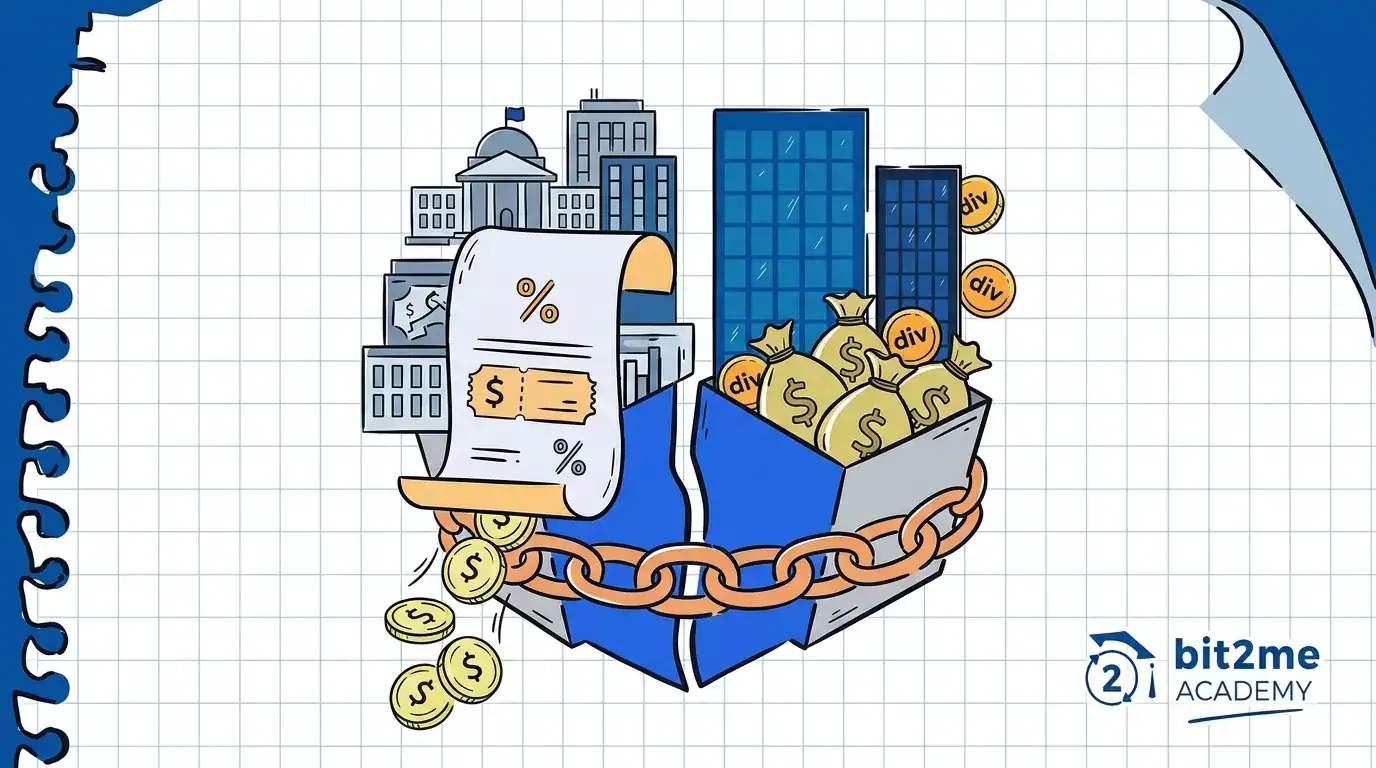
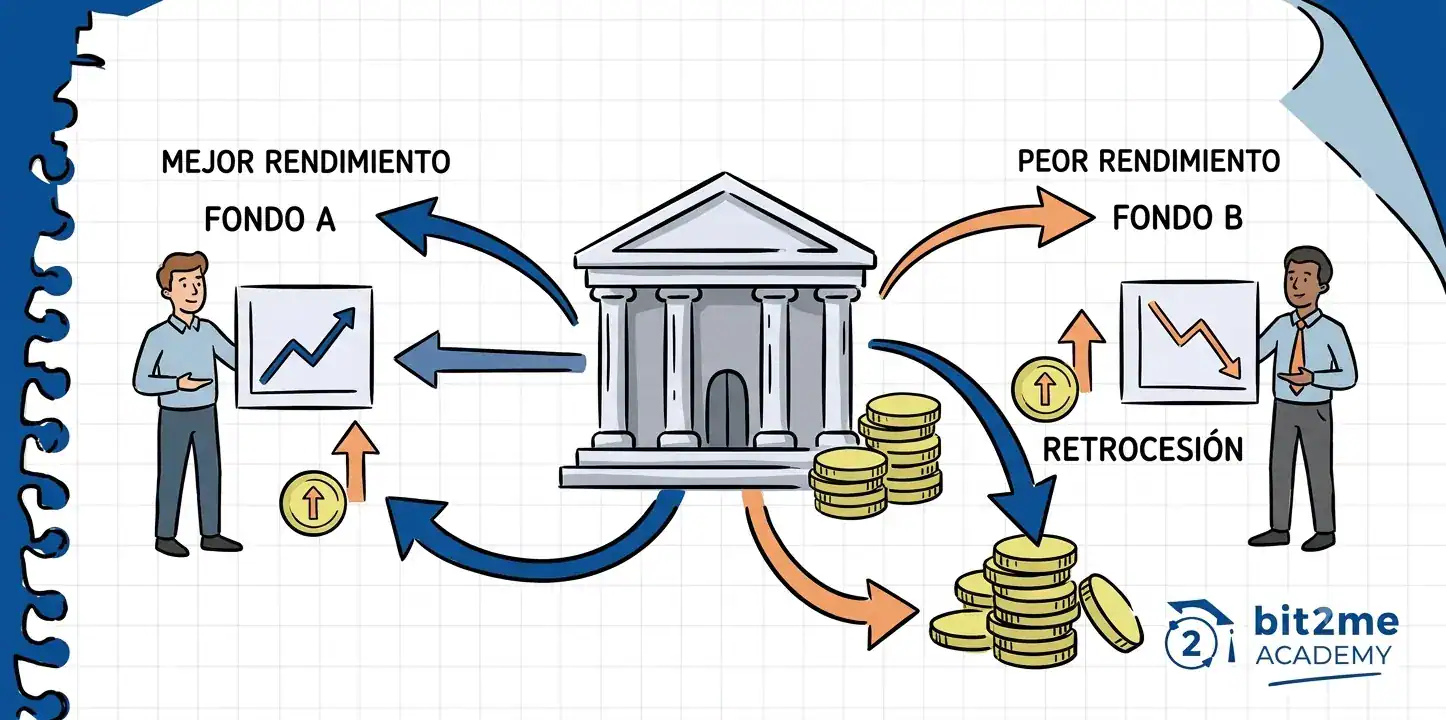
A retrocession is the payment a fund manager makes to a bank or other distributor in exchange for placing that fund with its clients. Essentially, the manager is saying: "Sell my funds and I'll give you a percentage of the fees I charge investors."
The investor doesn't see that payment on any statement. It doesn't appear as a separate line item. It's embedded in the fund's TER—the total annual cost the investor bears—in the form of a distribution fee that goes to the bank, not to the asset manager or the investor.
The best analogy is this: imagine a supermarket where certain manufacturers pay to have their products displayed at eye level, on the most visible shelves, while others are relegated to the lower shelves. The supermarket doesn't advertise this. You buy the product in front of you, believing it's the best-positioned one based on merit. The system works the same way with funds: the preferred position in the portfolio recommended by the bank comes at a price that someone paid.
 Certificate
How does the bank decide which funds to recommend to you?
When a bank presents you with investment funds, it has two types of options: funds from its own management company —from the same banking group— and funds from external management companies with which it has distribution agreements.
For external investors, fund managers negotiate the amount of retrocession they will pay. The higher the retrocession, the greater the bank's incentive to invest in that fund. This doesn't mean the bank doesn't consider other factors—historical performance, risk profile, client suitability—but it does mean that the system of financial incentives systematically pushes investors toward the funds that generate the most retrocession, regardless of whether they are the best fit for them.
The practical result is that the catalog your bank presents isn't an objective selection of the best available funds. It's a selection filtered by commercial agreements. Some of the best funds on the market, with lower TERs and longer track records, simply aren't available at your branch because their management company doesn't pay retrocessions or pays them at a lower rate.
Banking group funds: the most obvious conflict
When a bank recommends funds from its own asset management company, the conflict of interest is even more pronounced. The retrocession is internal—the entire margin stays within the group—and the incentive to prioritize those funds over third-party funds is at its maximum.
This is not an illegal practice. The funds of the banking group can be perfectly valid products. The problem is structural: the entity advising you and the entity managing the fund it recommends are the same. This conflict is difficult to eliminate internally, and MiFID II acknowledges it by requiring disclosure, although it does not prohibit it.
What MiFID II requires disclosure — and what hasn't changed
Since 2018, the MiFID II directive has required financial institutions in Spain to inform clients about the incentives they receive for distributing funds. Before signing a contract, investors must be informed whether the institution charges retrocessions and, if so, the amount.
It was a real regulatory step forward. The complete lack of transparency that existed before MiFID II was worse than the current situation. The problem is that "the information exists" does not equate to "the system has changed." Information about retrocessions appears in lengthy contractual documents that most investors don't read in detail before signing. The incentive structure remains unchanged.
The conclusion drawn from the regulations themselves is clear: if it were necessary to require disclosure of incentives, it would be because those incentives could create conflicts of interest unknown to the client. MiFID II identified the problem without solving it. The truly independent model is not the one that reports retrocessions—it's the one that doesn't collect them.

Open architecture: the model where the advisor doesn't charge for making recommendations
There is an alternative model to the retrocession system, and it has a name: open architecture. In this model, the distributor receives no payment from the asset managers for placing their funds. Product selection is done without external financial incentives: based on objective criteria such as cost, historical performance, diversification, and suitability to the investor's profile.
Open architecture eliminates conflicts of interest at their root. The distributor has no economic incentive to recommend one fund over another based on the retrocession it generates. Their incentive is directly aligned with your interests as an investor.
In the open architecture model, the funds listed in the catalog are there because they meet quality criteria, not because their manager paid to be included. As a result, the available share classes tend to be clean and institutional—those with the lowest TER—rather than the more expensive, dirty ones.
Why Bit2Me Does Invest operate without retrocessions?
Bit2Me Invest, through InbestMe, distributes funds under an open architecture model: without retrocessions from managers, without external economic incentives that condition which funds appear in the catalog.
The practical result is a portfolio comprised of clean share classes and institutional share classes—those with the lowest TER available on the market—accessible from a minimum investment of €1. The average TER of the portfolio is approximately 0,8% in Phase 1*, compared to approximately 2,5% for the most widely marketed funds offered by traditional banks.
Bit2Me Invest doesn't charge commissions to asset managers. Its revenue model isn't dependent on you buying specific funds: it can offer you the entire catalog without filtering based on what's most profitable for the platform. This is a model where the distributor's and investor's incentives are aligned.

Frequently asked questions about retrocessions in investment funds



 Author