Essential Points
- A cryptocurrency wallet stores the keys that prove and allow you to move your crypto assets, not physical "coins" within an app.
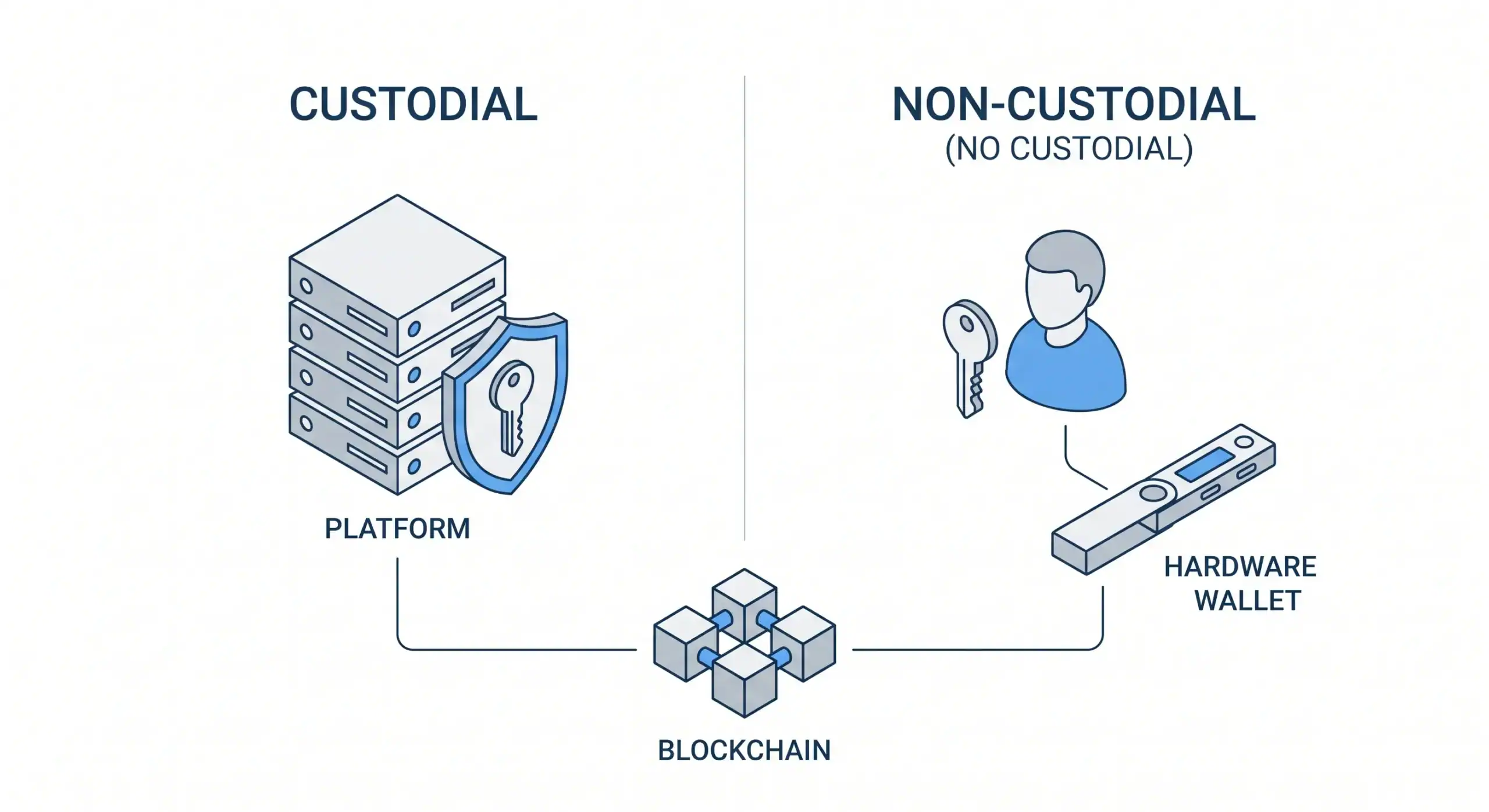
- The real difference between custodial and non-custodial is who controls the private key: the platform or yourself.
- Moving assets from an exchange to your own wallet changes responsibilities: you gain autonomy, but you also assume the burden of protecting your own access.
- There is no "perfect" option: the right wallet depends on your profile, your asset volume, and how much friction you are willing to accept.
You've already bought your first cryptocurrencies on an exchange and now you're wondering if you should move them to a wallet you control yourself. This is an increasingly common question: as the digital asset ecosystem matures, more users understand that leaving their funds on an exchange platform means entrusting custody to a third party. Choosing the right cryptocurrency wallet isn't a minor technical detail; it's the decision that determines who has the final say over your funds and what you can do if something goes wrong.
In this article, we compare the two custody models available today—custodial and non-custodial—explaining who controls the private key in each case, the advantages and limitations of each model, and which cybersecurity certifications you should review before entrusting your assets to a provider. You'll also find a comparison table and a practical guide to help you decide based on your user profile, whether you trade occasionally or manage a larger volume of crypto assets.
What is a wallet and what does custodial versus non-custodial mean?
A wallet doesn't "contain" crypto assets in the same way a physical wallet contains banknotes. Crypto assets always exist as records on the blockchain; what the wallet stores and protects is the private key, the cryptographic data that proves ownership of those assets and authorizes any transaction. It's also called a cryptocurrency wallet or digital wallet, although from here on we'll use wallet, the more common term in the industry.
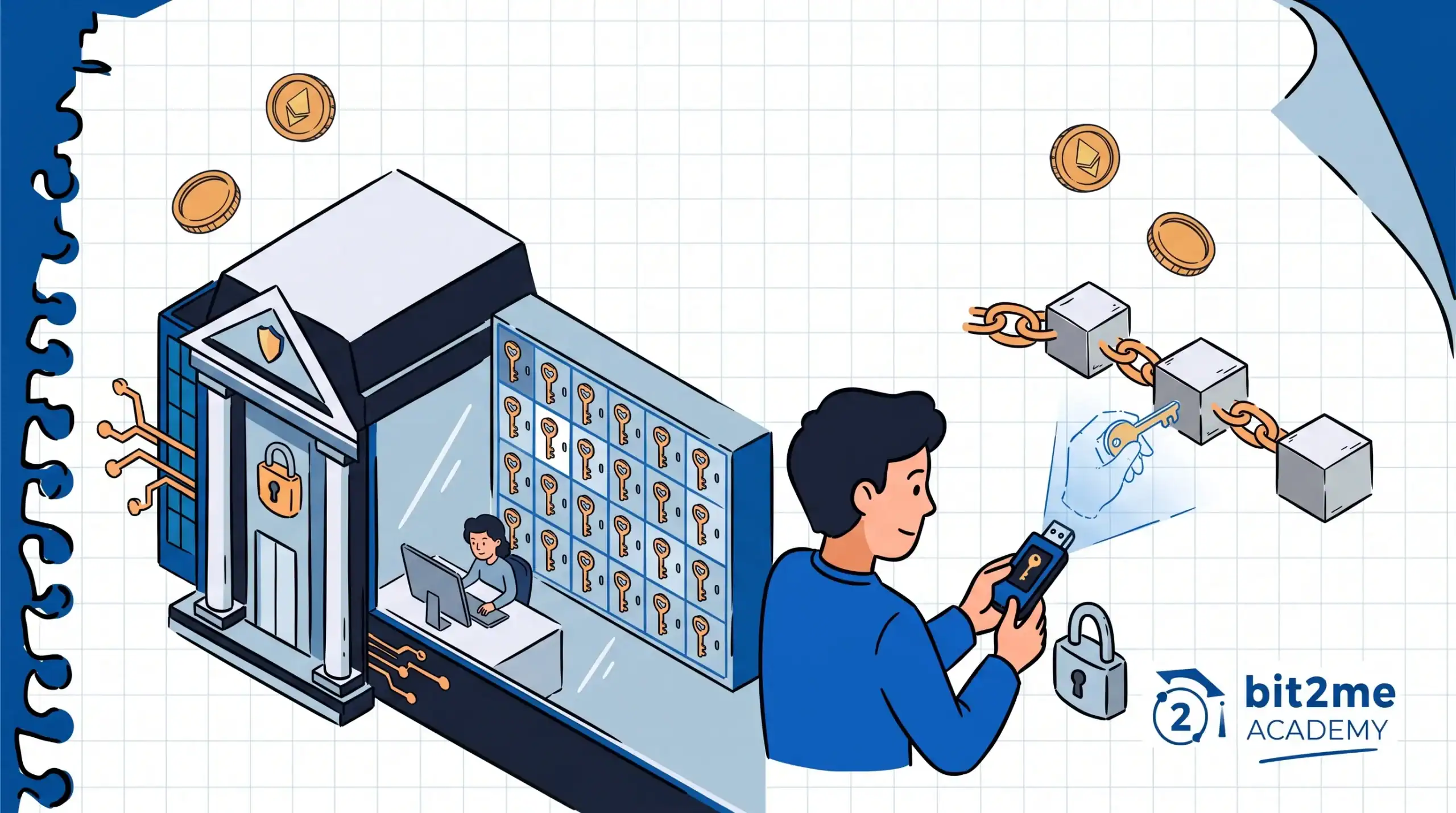
The difference between custodial and non-custodial wallets boils down to a single question: who holds that private key? In a custodial wallet, a third party—usually the exchange or platform where you bought your crypto assets—generates, stores, and manages the key on your behalf. You access your funds with a username and password, similar to how you would access any online account, while the platform handles the underlying cryptographic infrastructure.
In a non-custodial wallet, on the other hand, you directly generate and control the private key, typically backed by a seed phrase that only you know. There is no intermediary between your decision to move funds and the execution of that transaction on the blockchain. This difference—delegated control versus direct control—is the central theme underlying all the decisions you will see in the rest of this article.
This comparison is part of the broader Exchange & Wallet guide from Bit2Me Academywhere we delve into how exchange platforms and the various custody models available today work. If your context is business-oriented, the logic shifts in scale: institutional custody of crypto assets adds layers of governance, access control, and reporting, which we cover in our dedicated business content.
Advantages and limitations of the custodial wallet
For most users starting out with cryptocurrencies, a custodial wallet is the natural entry point: it's the one automatically managed by the exchange where you opened your account. Its main appeal is that it transfers the technical complexity of custody to the provider, in exchange for your trust in its operational reliability and regulatory framework.
Among its most relevant advantages are the following.
- You don't need to manage the private key yourself or memorize a seed phrase.
- Access recovery is easier if you forget your password, through identity verification processes.
- The user experience is simplified, designed for those taking their first steps with crypto assets.
- The integration with the purchase, sale and conversion of assets is direct, within the same platform.
- Customer support is available if you have any questions or issues with your account.
The downside is that you are completely dependent on the operational and security reliability of the provider that holds your keys. You have no direct control over the private key, which means that any operational restrictions, technical issues, or platform verification processes can temporarily limit your access to the funds. Therefore, it's advisable to always work with providers that are authorized as cryptocurrency service providers and can demonstrate their security procedures.
Advantages and limitations of the non-custodial wallet
A non-custodial wallet reverses the equation: you generate and store the private key, usually through software installed on your device or a dedicated physical device (hardware wallet). This gives you complete autonomy, but also shifts all the responsibility previously assumed by the platform onto you.
Its main advantages are the following.
- Full and direct control over the private key and, therefore, over your crypto assets.
- Independence from the operational availability of a third party: no one can unilaterally restrict access to your wallet.
- Greater privacy in the daily management of your assets, without intermediaries in each transaction.
- Broad compatibility with decentralized applications and DeFi (Decentralized Finance) protocols.
In return, the entire responsibility for protecting access falls on you. If you lose the seed phrase and the device where you saved it, there is no technical support, authority, or provider that can restore access to those funds. This is probably the most important difference compared to the custodial model: there is no "forgot my password" with assisted recovery, and this demand for personal discipline is the price of autonomy.
Security and verifiable certifications: what a wallet guarantees and what it doesn't.
The security of a cryptocurrency wallet is not a one-size-fits-all concept: it varies depending on the custody model and which part of the system you're evaluating. In the case of custodial wallets, it's advisable to check if the provider has cybersecurity certifications audited by independent third parties, and not just generic claims of a "secure platform."
Bit2MeFor example, it has certifications such as ISO 27001 (information security management), ISO 22301 (business continuity), and CSA STAR (cloud security). These certifications independently assess an organization's internal processes for data protection, incident management, and service availability.
It's important to understand exactly what these certifications entail. They audit the cybersecurity management and operational continuity of the organization that obtains them, but they don't completely eliminate the possibility of incidents or make any platform a risk-free system: no technology provider can offer an absolute guarantee against attacks or failures. In a non-custodial wallet, however, there isn't an organization to audit in this regard: security depends almost entirely on the user's own practices, such as physically safeguarding the seed phrase and using malware-free devices.
Seed phrase and basic good custody practices
The seed phrase is the master key to a non-custodial wallet: a sequence of 12 to 24 words that allows you to restore full access to your crypto assets on any compatible device. Whoever has this seed phrase has control of the funds, regardless of who the legitimate owner is.
That's why basic good practices all revolve around the same principle: minimizing the exposure of that phrase.
- Never share the seed phrase with anyone, not even with a platform's technical support.
- Never write it down or save it in plain text within an email, a photo, or a note in the cloud.
- Never enter it on a page or application that you do not recognize as the official software of your wallet.
In this guide we focus on comparing custody models; the detailed step-by-step process for generating, annotating, and properly protecting your seed phrase is developed in another guide Bit2Me Academy dedicated specifically to wallet security.
 Certificate
Governance and internal risk policy
No addition of crypto assets to the treasury should occur without an updated investment and risk policy that explicitly addresses this asset class. This policy must define, at a minimum, the maximum percentage of the balance sheet allocated to crypto assets, the entry and exit criteria, the individuals responsible for implementation, and the body that approves any exceptions. The absence of this prior framework is, in practice, the most frequent red flag detected by external auditors when reviewing these types of transactions.
Governance also requires clearly defining the necessary approval level based on the amount. A minor transaction can be delegated to the treasurer, while any significant movement should require approval from the finance committee or, depending on the company's size, the board of directors. This threshold-based approval scheme is not unique to crypto assets, but its absence in this specific area generates a higher reputational and internal control risk than other, more conventional treasury decisions.
An often-overlooked element of governance is internal training. The finance team that will be working with crypto assets needs to understand, beyond theory, how on-chain transactions function, what an irreversible confirmation means, and why a destination address error is irreversible. Bit2Me Academy It has specific training content for financial teams starting out in this field, complementary to the B2B / Companies content pillar where the rest of the platform's corporate resources are grouped.
Finally, the risk policy should include a procedure for periodic review, not just initial approval. Cryptocurrency markets, MiCA regulations, and institutional custody practices evolve rapidly, and a policy approved two years ago may have become outdated without anyone formally notifying them.
Citable checklist: first steps to incorporate crypto assets into corporate treasury
Before proposing any move to the finance committee or the board, a treasury department should be able to respond in a documented manner to the following points.
- Internal investment and risk policy: there is an approved document that defines the maximum percentage of balance allocated to crypto assets, the entry and exit criteria, and those responsible for each decision.
- Custody: the custody model has been decided (self-managed, delegated to an institutional provider or hybrid with multisig) and the MiCA authorization of the chosen provider has been verified.
- Accounting controls: there is a defined accounting criterion validated with the external auditor for the registration, periodic valuation and eventual impairment test of the asset.
- Applicable MiCA framework: The regulatory authorization of any crypto asset service provider involved in the transaction has been reviewed, including the safeguarding of customer assets.
- Governance: the approval scheme by amount thresholds and the body responsible for the continued monitoring of the position have been defined.
This checklist does not replace individualized analysis of each company or specialized legal, tax, and financial advice tailored to each specific case. Its purpose is to serve as a quotable starting point for a finance department to internally structure the discussion before moving forward. Companies wishing to explore any of these points in greater depth can contact the B2B team at Bit2Me to review the institutional custody framework and operational requirements applicable to legal entities.
How to choose your wallet according to your user profile?
If you trade frequently, move moderate amounts, and value simplicity above all else, a custodial wallet within a licensed exchange will likely meet your needs without any added friction. The process of buying, converting, and managing your crypto assets happens all in one place, and you can always turn to support if anything goes wrong.
However, if you accumulate a growing volume of crypto assets that you don't need to move daily, or if you want to interact directly with DeFi protocols, direct control of the private key starts to outweigh convenience. In that scenario, adopting the discipline of protecting your own seed phrase usually compensates for the added friction involved in managing it.
A common practice among users with your profile—already familiar with an exchange but beginning to consider self-custody—is to combine both models: keeping only what's necessary for efficient trading on the platform and transferring the rest to their own wallet. If, after this comparison, you decide to take direct control of your keys, you can create your non-custodial wallet. Bit2Me in just a few minutes, without needing to close your exchange account for trades where you prefer to maintain immediate liquidity.
The fundamental question isn't which model is better in the abstract, but which one best suits how you actually use your crypto assets. If you value simplicity and trade frequently, a custodial wallet on a permissioned platform might be sufficient for your current needs. If you prioritize direct control over your funds and are willing to take on the responsibility that comes with it, moving a portion to your own cryptocurrency wallet is a logical step in your journey. Whatever your decision, periodically reviewing how and where you store your digital assets is a habit worth maintaining as your experience with the crypto ecosystem grows.

Frequently asked questions about custodial and non-custodial wallets



 Author