Essential Points
- Unalterable Mathematical Scarcity: By early 2026, more than 95% of the total supply (21M) had already been issued, intensifying the narrative of Bitcoin as a global reserve asset against inflationary fiat currencies.
- Impact of the Halving Cycle: The reduction of the block reward to 3,125 BTC in 2024 continues to set the pace of issuance for 2026, establishing a floor of annual production significantly lower than projected institutional demand (ETFs).
- Sustainability of the Post-Emission Network: The debate about the year 2140 is not about the disappearance of Bitcoin, but about the complete transition of the mining incentive from issuing subsidies to transaction fees.
- Security and Hashrate: The mining difficulty continues at all-time highs even though there are less than 1 million BTC left to produce, validating the robustness of the network as the most secure computing system in the world.
The Engineering of Scarcity: Why Code Is Law
The supply constraint on the Bitcoin network is not a miscalculation or a technical whim; it is the cornerstone of its entire financial architecture. While in the traditional system we see central banks printing fiat currency at a rate that erodes purchasing power, this cryptocurrency operates under a diametrically opposed logic. Here, there is no room for political improvisation or for "bailouts" that devalue the efforts of savers.
This scarcity is protected by two rules that, to this day, remain unbreakable: the maximum limit (hard cap) and an emission that decreases mathematically. Satoshi Nakamoto He didn't invent anything new under the sun, but rather digitized nature: He programmed the protocol to mimic gold mining.At first, anyone with a basic computer could earn rewards; today, in 2026, the difficulty has escalated to such an extent that only extreme efficiency survives.
How is balance maintained? Through "Difficulty Adjustment"This mechanism ensures that even if all the world's computing power were connected to the network tomorrow, blocks would still be generated every ten minutes on average. It's a digital Swiss watch that ignores market pressures. In the current landscape, this mathematical certainty is the magnet that attracts investment funds: they prefer to trust an auditable equation rather than the promise of a committee of experts.
The 21 million ceiling: The final frontier
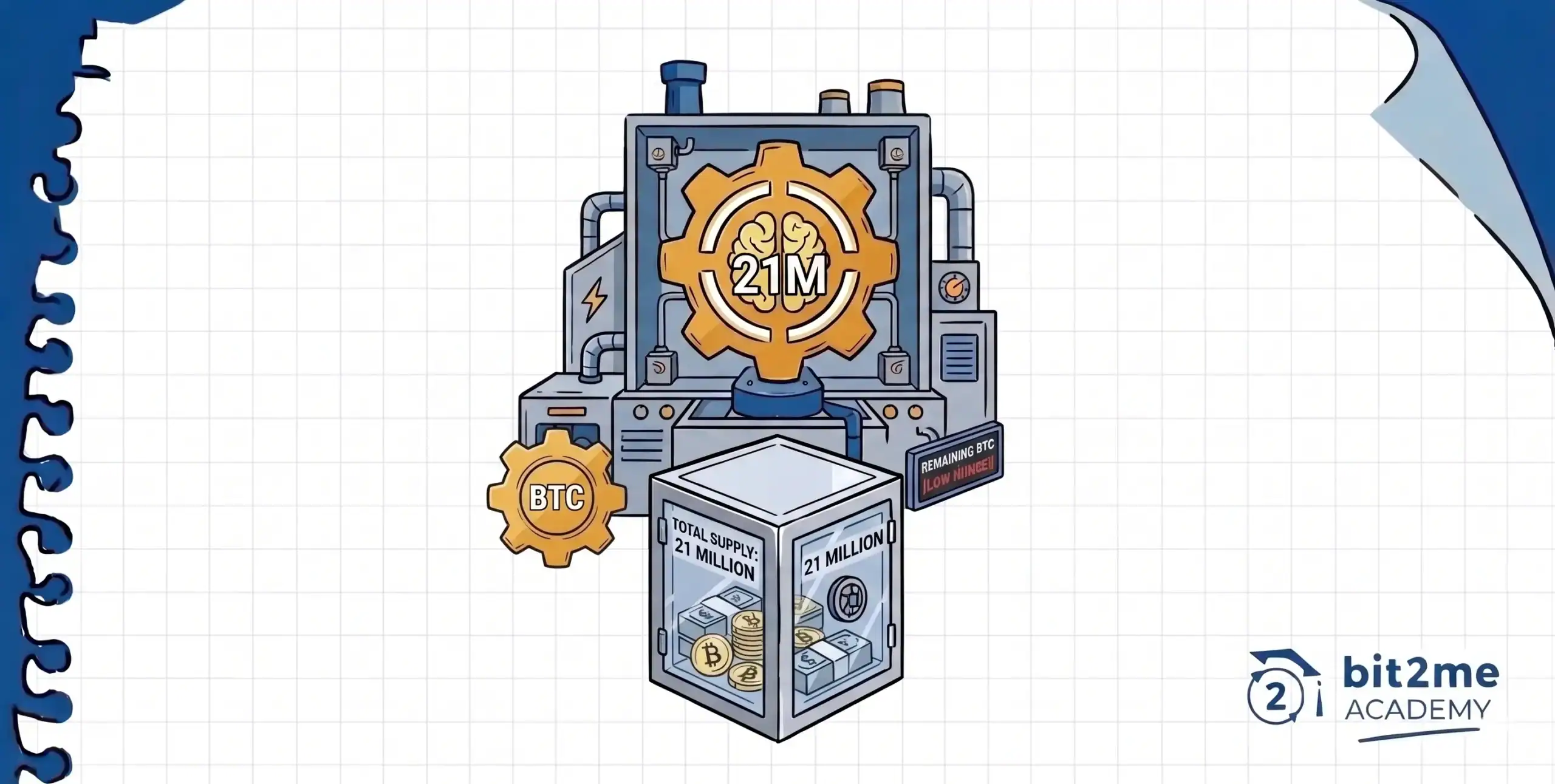
If there's one number you should get tattooed if you're interested in digital assets, it's this: 21.000.000. Not one more. This absolute limit is what defines "absolute digital scarcity." But where does this number come from? It's not a figure chosen at random to make headlines.
The technical explanation is pure mathematical elegance. It's based on the sum of a geometric series derived from the halvings. Rewards started at 50 units per block and are halved every 210.000 blocks. If you follow that progression to the end, the result tends asymptotically to 21 million. It's a finite formula for a world of infinitely depletable resources.
In 2026, with a global population nearing 8.500 billion, the token's exclusivity is almost shocking. If we distributed the entire supply today, each person on the planet would receive a tiny fraction: a mere 0,0024 units.
This is where the famous "21 Million Club" comes into play. If you own an entire holding of this asset, you belong to an elite that, statistically speaking, cannot exceed 0,2% of humanity. And that doesn't even include the "whales" or coins lost on hard drives forgotten a decade ago. Today, possessing even a tiny fraction of this supply isn't speculation; it's a strategy for protecting your wealth in the face of global uncertainty.
How many Bitcoins are mined per day?
To understand the market's pulse in this first quarter of 2026, we must look directly at the heart of the protocol: the scheduled issuance. We are still under the effects of the fourth halving (that milestone in April 2024), which reduced the block reward from 6,25 to the current 3,125 tokens.
The network, unchanging in its design, continues to spit out a block approximately every 10 minutes. If you do the quick math—and your computer doesn't say otherwise—this gives us an average of 144 blocks per day. The math doesn't lie:
144 blocks/day * 3,125 tokens/block = 450 tokens/day
This figure, which seems normal to us today, is a mere trifle compared to the 7.200 that were issued back in 2009. We are in a phase of maturity where scarcity is no longer a theory, but a reality that tightens the market's grip every 24 hours.
Selling pressure in the current scenario
Those 450 tokens per day represent the maximum "ammunition" that miners can deposit on exchanges to pay their electricity bills and upgrade their ASIC equipment. However, in the context of 2026, this figure has become ludicrous. With the consolidation of institutional funds and corporate treasuries absorbing every fraction of available assets, the daily supply is unable to quench the thirst of global capital.
Do we really believe that 450 units can stop the price when institutional demand is in the thousands? Clearly not. We are facing a structural supply shock. While the fiat system continues to print debt, the tap of this cryptocurrency is increasingly being turned off, leaving miners in a position where only the most efficient (those who optimize every watt) manage to survive the shortage of issuance.
 Certificate
Introductory course to DeFi
Medium levelTime to update. Traditional finance has changed, discover the revolutionary ecosystem of decentralized finance (DeFi).
The scarcity counter: How many assets are already in circulation?
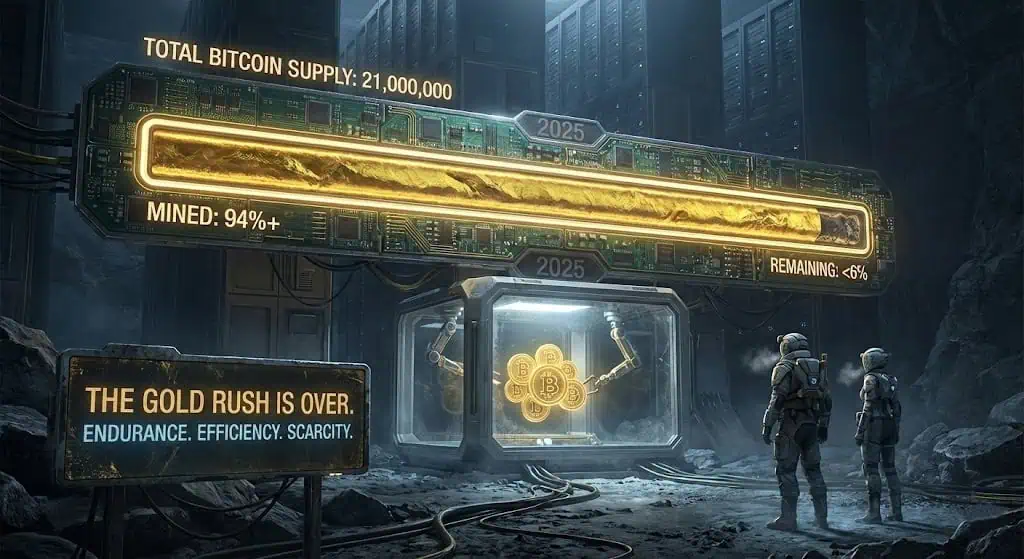
Since the launch of the Genesis Block on January 3, 2009, the network hasn't stopped for a single second. Block after block, the protocol has released units with astonishing mathematical precision. Now, in March 2026, the global total of issued crypto assets has surpassed 20 million.
The emission curve, designed to be aggressive in its infancy and extremely sparing in its maturity, gives us a fascinating historical snapshot of the distribution of this digital wealth:
- Fifty percent of the supply (10,5 million) was generated in just four years (2009-2012). A time of abundance for the few who recognized the potential.
- The 75% was reached in 2016, marking the end of the era of "easy money" from the home computer.
- 90% was completed by the end of 2021, when the asset was already a coveted piece on Wall Street.
In this first quarter of 2026, we have already exceeded the 95% threshold.
The end of the initial distribution
What does this mean for you? Basically, that the big pie has already been divided. We're no longer in that romantic phase where miners were the sole owners of the flow. By 2026, validators will barely contribute a drop of water in an ocean of liquidity dominated by the secondary market: exchanges, institutional funds, and government treasuries.
Entering the ecosystem today doesn't make you an "early adopter" in the technical sense of mining, but rather a participant in a mature and highly competitive market. Every new token released now requires an industrial infrastructure and energy deployment that would dwarf any traditional manufacturing plant. The distribution phase is over; we are in the era of consolidation and professional custody.
Key dates of Bitcoin halvings (2009 – 2140)
The "halvings" These are the most important events on the Bitcoin calendar, acting as the heartbeat of its monetary policy. They occur every 210.000 blocks (approximately every 4 years). Here are the key past and future dates that define the mining era:
| Event | Estimated Year | Block # | Reward (BTC) | Status |
|---|---|---|---|---|
| Launch (Genesis) | 2009 | 0 | 50.00000000 | Past |
| 1rd Halving | 2012 | 210,000 | 25.00000000 | Past |
| 2nd Halving | 2016 | 420,000 | 12.50000000 | Past |
| 3rd Halving | 2020 | 630,000 | 6.25000000 | Past |
| 4nd Halving | 2024 | 840,000 | 3.12500000 | Present |
| 5nd Halving | 2028 | 1,050,000 | 1.56250000 | future |
| 6nd Halving | 2032 | 1,260,000 | 0.78125000 | future |
| 7nd Halving | 2036 | 1,470,000 | 0.39062500 | future |
| 8nd Halving | 2040 | 1,680,000 | 0.19531250 | future |
| 9nd Halving | 2044 | 1,890,000 | 0.09765625 | future |
| 10nd Halving | 2048 | 2,100,000 | 0.04882812 | future |
| 11nd Halving | 2052 | 2,310,000 | 0.02441406 | future |
| 12nd Halving | 2056 | 2,520,000 | 0.01220703 | future |
| 13nd Halving | 2060 | 2,730,000 | 0.00610351 | future |
| 14nd Halving | 2064 | 2,940,000 | 0.00305175 | future |
| 15nd Halving | 2068 | 3,150,000 | 0.00152587 | future |
| 16nd Halving | 2072 | 3,360,000 | 0.00076293 | future |
| 17nd Halving | 2076 | 3,570,000 | 0.00038146 | future |
| 18nd Halving | 2080 | 3,780,000 | 0.00019073 | future |
| 19nd Halving | 2084 | 3,990,000 | 0.00009536 | future |
| 20nd Halving | 2088 | 4,200,000 | 0.00004768 | future |
| 21nd Halving | 2092 | 4,410,000 | 0.00002384 | future |
| 22nd Halving | 2096 | 4,620,000 | 0.00001192 | future |
| 23nd Halving | 2100 | 4,830,000 | 0.00000596 | future |
| 24nd Halving | 2104 | 5,040,000 | 0.00000298 | future |
| 25nd Halving | 2108 | 5,250,000 | 0.00000149 | future |
| 26nd Halving | 2112 | 5,460,000 | 0.00000074 | future |
| 27nd Halving | 2116 | 5,670,000 | 0.00000037 | future |
| 28nd Halving | 2120 | 5,880,000 | 0.00000018 | future |
| 29nd Halving | 2124 | 6,090,000 | 0.00000009 | future |
| 30nd Halving | 2128 | 6,300,000 | 0.00000004 | future |
| 31nd Halving | 2132 | 6,510,000 | 0.00000002 | future |
| 32nd Halving | 2136 | 6,720,000 | 0.00000001 (1 Sat) | future |
| 33rd Halving (Final) | ~ 2140 | 6,930,000 | 0.00000000 | End of broadcast |
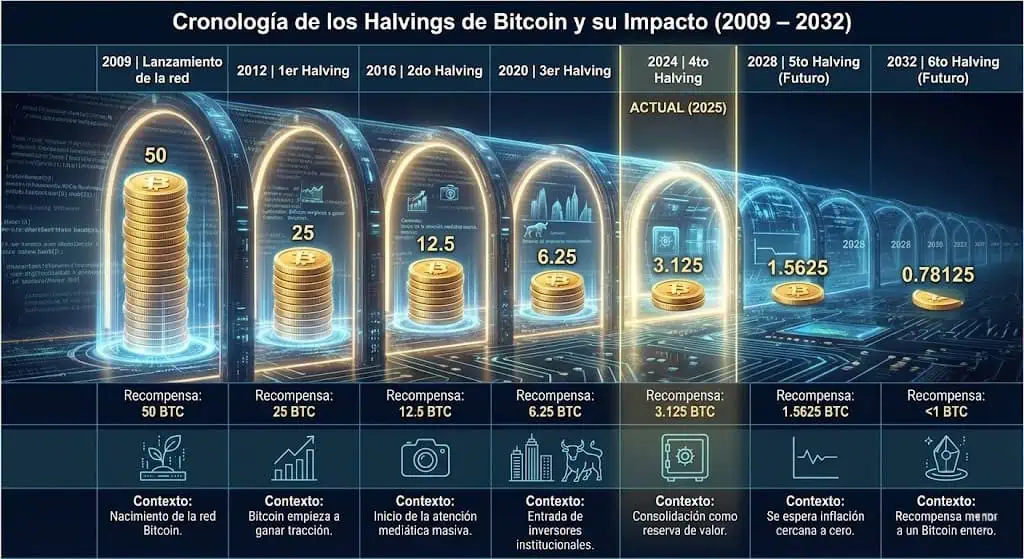
Looking further into the future, these events will continue to reduce the supply of new gold until the rewards become negligible. In 2025, we are experiencing the direct effects of the 2024 halving, a period where the supply has dried up considerably, setting the stage for the next cycle around 2028.
When will Bitcoin mining end?
Although over 95% of Bitcoins will have been mined by 2026, the remaining 5% will take more than a century to complete. According to the protocol's mathematical calculations, the last Bitcoin (or more precisely, the last satoshi) will be mined around the year 2140.
This extended period is due to the exponential nature of the halvings. As the reward is halved every four years, it becomes progressively smaller, extending the emission period asymptotically.
- By 2035, 99% of all Bitcoins will have been mined.
- The remaining 1% will take more than 100 years to extract.
This means that, for practical investment and market purposes, near-total scarcity will be felt well before 2140. Our generation and the next will see Bitcoin issuance become virtually irrelevant compared to the existing stock.
The future of Bitcoin mining
If the block reward is 3,125 BTC in 2025 and continues to decline, how will miners survive in the future? The answer lies in transaction fees. The future of Bitcoin mining will depend less and less on the "subsidy" of new Bitcoins and more on network usage. As the network is used to settle high-value transactions, the fees users pay to be included in a block will either increase or remain constant, offsetting the decline in the issuance of new coins.
By 2025, we'll already see this trend: mining is merging with the energy industry and AI. Miners are helping to stabilize power grids by using surplus renewable energy (hydroelectric, solar, wind) and landfill gas that would otherwise be burned. At the same time, they're transforming their mining facilities into massive computing infrastructures for AI, thereby securing new markets. Furthermore, with the expansion of "Layer 2" solutions like the Lightning Network, Bitcoin is becoming a final settlement layer.
The miner of the future will not only be a cryptocurrency speculator, but also a cybersecurity service provider and a key partner in global energy infrastructure. Mining will be greener, more institutionalized, and entirely dependent on operational efficiency.
FAQ – How many Bitcoins are left to mine in 2026?



 Author